Short answer: a pre-trade checklist is a short list of conditions you check, in the same order, before every entry, and a rule for what happens when one fails. The one below is the checklist Signal Desk runs on every closed candle. Five setup checks (trend, momentum, structure, location and candle) count to a grade: five is an A, four a B, three a C. Then come limits that can refuse the entry whatever the grade: three chase vetoes, a daily cap of 2 entries, a cooldown and an entry window. An A means all five checks agreed. It is a count, not odds.
This post lists each check with the number behind it, says why a checklist and why a plain count, and explains what an A grade is and isn't. Then you tick the five yourself on one simulated chart, and the drill shows the grade and why that grade alone doesn't make an entry. The whole list fits on a one-page PDF and in a spreadsheet.
What is a pre-trade checklist?
A checklist turns "does this look good?" into questions with yes-or-no answers, asked in the same order every time. Each line names one condition and how to read it from the chart. A pre-trade checklist adds the other half: what a "no" does. Some lines lower the grade, and some refuse the trade outright.
Checklists earned their name where skipping a step is expensive. In the New England Journal of Medicine in 2009, Haynes and colleagues "hypothesized that a program to implement a 19-item surgical safety checklist designed to improve team communication and consistency of care would reduce complications and deaths associated with surgery." They reported: "The rate of death was 1.5% before the checklist was introduced and declined to 0.8% afterward (P=0.003). Inpatient complications occurred in 11.0% of patients at baseline and in 7.0% after introduction of the checklist (P<0.001)."
That was a before-and-after study in operating theatres, and the authors' own summary is careful: "Implementation of the checklist was associated with concomitant reductions in the rates of death and complications". It says nothing about trading. What carries over is what the checklist was for: consistency, the same steps done every time.
The trading checklist: five checks before entering a trade
These are the five setup checks Signal Desk grades, in its manual's words, then in plain numbers from its defaults. They read a long; shorts mirror them. The desk reads them on a closed candle where its trigger fired. The default trigger is a pullback: in the manual's words, "price visits the fast average, then gives a strong close beyond it as momentum turns." A checklist doesn't find trades. It grades the ones your trigger finds.
- Trend. "Supertrend and fast/slow EMA direction agree." Supertrend (10, 3) points up and the 20 EMA is above the 50 EMA.
- Momentum. "RSI is on the trade’s side of its average and 50." RSI (14) is above its 14-candle average and above 50.
- Structure. "the last confirmed swing break agrees." The last confirmed swing a close broke was a swing high. A swing needs 5 candles on each side, so it confirms 5 candles late.
- Location. "close is near the fast EMA; long range is half an ATR below to one ATR above. Shorts mirror it." The close is between 0.5 ATR below and 1 ATR above the 20 EMA, with ATR (14).
- Candle. "a strong directional body, close near its extreme, and no oversized range." A green candle whose body is at least 40% of its range, whose top wick is at most 35% of it, and whose range is at most 2.5 ATR.
Then count them. The manual: "Default grades: A = five, B = four, C = three. Minimum B. Raising the minimum reduces qualifying setups; it does not establish better outcomes." A trigger graded below the minimum doesn't fire.
Why these five? Each asks a different question. Trend asks whether you're trading with the slower move, momentum whether the push is still there, structure whether price has broken the last swing in your direction, location whether you're entering near the average or far from it, and the candle whether this close is strong without being oversized. They don't all have to agree. That's what the count is for.
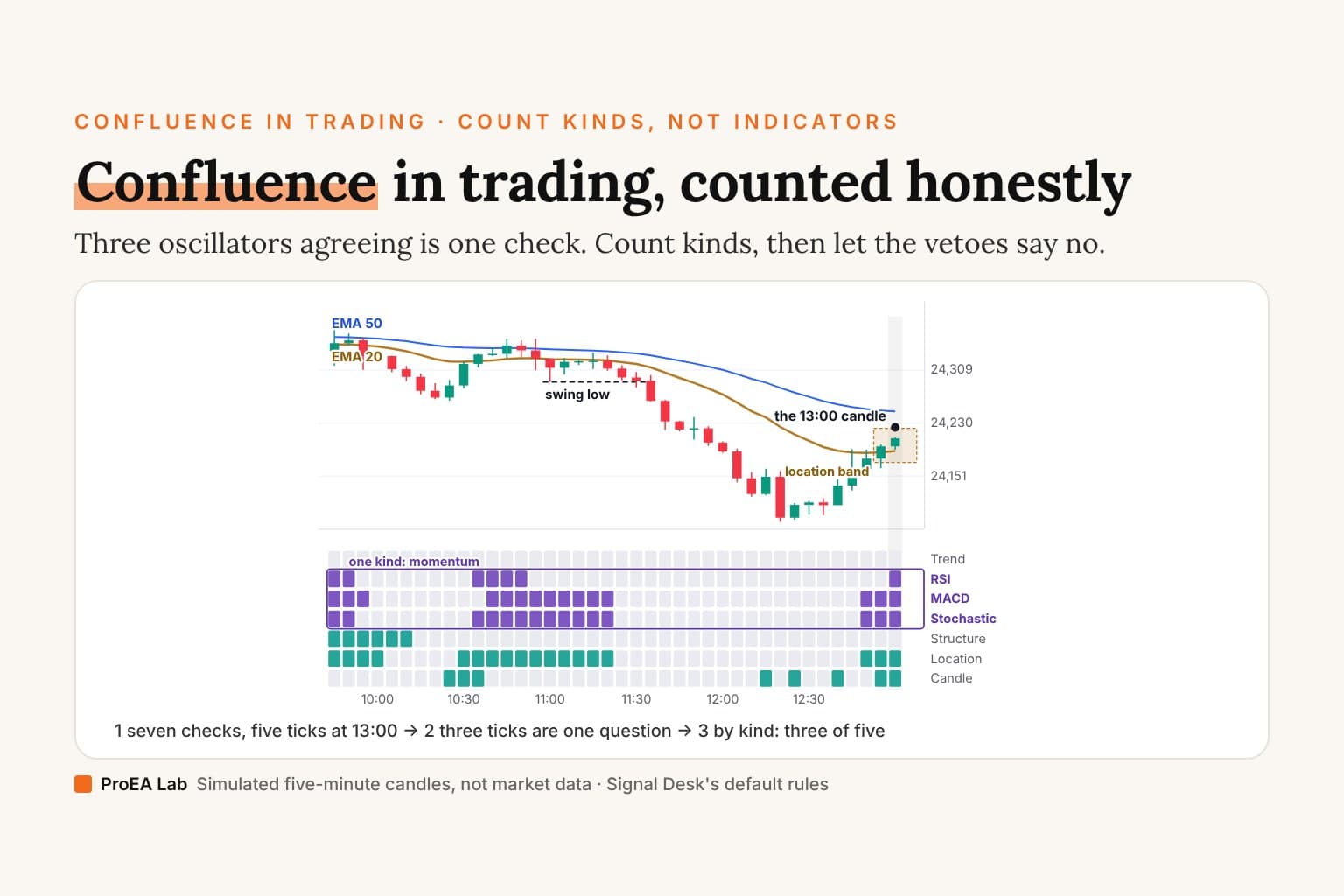
This is what traders call confluence: several independent conditions agreeing on one candle. The word that matters is independent. One check of each kind counts honestly; RSI, MACD and stochastic on one list would be one momentum question asked three times, and would add three to a count that has learned one thing. Why, with the numbers and a drill: confluence in trading, counted honestly.
Then the limits: three chase vetoes
The vetoes come after the grade, and any one of them refuses the entry. The desk was built for an options buyer whose worst trades came right after a big candle, so these three are about one thing: not buying the end of the move.
- Oversized candle. Skip it if the candle's range is more than 2.5 ATR.
- Stretched. Skip it if the close is more than 2 ATR beyond the 20 EMA in the trade's direction.
- Late in a run. Skip it if the last three closes span more than 3 ATR and the close is beyond the close three candles ago in the trade's direction.
In the manual's words: "Any one blocks it: candle high–low range above 2.5 ATR; directional stretch from fast EMA above 2 ATR; or range of the last three closes above 3 ATR, with the close beyond the close three candles ago in the entry direction. Exact equality passes."
Notice how location and stretch share a ruler. A close more than 1 ATR above the 20 EMA fails the location check and costs one grade point, so a B can still fire. More than 2 ATR above it, the stretch veto refuses the entry whatever the grade.
A day trading checklist: the window, the daily cap and the cooldown
For intraday trading the checklist adds the day itself. These are Signal Desk's defaults, set in India time for the index chart it was built on; set your own market's hours.
- Entry window. Enter only on candles that open from 09:30 to before 14:45, India time by default. In intraday mode, an open trade is squared off on the first closed candle that opens inside 15:00 to 15:15.
- Daily cap. At most 2 entries a day, both directions together.
- Cooldown. Wait 6 candles after an exit.
- One at a time. No new entry while a trade is open.
Signal Desk's page puts the order plainly: "The grade counts setup checks; it does not override the entry gates. The selected trigger, chase limits, session window, daily allowance, cooldown and existing trade state must also permit an entry on the confirmed candle." Some days that means no entry at all, which is the cap and the window doing their job.
Why count the checks instead of weighing them?
Because a plain count holds up better than it sounds. Dawes's 1979 paper in American Psychologist is about "improper linear models", those whose weights are obtained "on the basis of intuition, derived from simulating a clinical judge's predictions, or set to be equal." Its abstract: "This article presents evidence that even such improper linear models are superior to clinical intuition when predicting a numerical criterion from numerical predictors. In fact, unit (i.e., equal) weighting is quite robust for making such predictions."
Five checks, each worth one point, is exactly that kind of model. Dawes's evidence is about combining predictors in general, not about trades, so it supports the method (count, don't agonize over weights), not a promise about what the count predicts. Signal Desk keeps the plain count as its default grade and offers a learned score as an option. Whether the count, the learned score or a stricter grade ranked trades better on one index chart, with costs on, is what our Signal Desk study tested; it prints what it measured, with its sample and its limits.
What is an A+ setup in trading?
"A+ setup" is trader slang for the trade where everything on your list agrees. On Signal Desk that is an A: all five setup checks on the closed candle. B is four of five, C three.
What an A is: a count of conditions that were present when the signal fired. What it isn't: odds. Signal Desk Premium's page says it in two lines: "Conditions, not odds. A means all five setup factors were there, B four, C three; a grade says nothing about how likely a trade is to work." The library desk's manual answers "Does grade A mean this trade will win?" with: "No. In the default mode it means all five setup checks agree. It is a count, not a probability. The other entry limits still apply."
So an A still has to clear the vetoes and the day's limits, and it can still lose. If you want to know whether A beat B on a market, measure it on that market with costs on, and read the study for how we did that on one chart and what it showed.
Tick it yourself: one chart, five checks
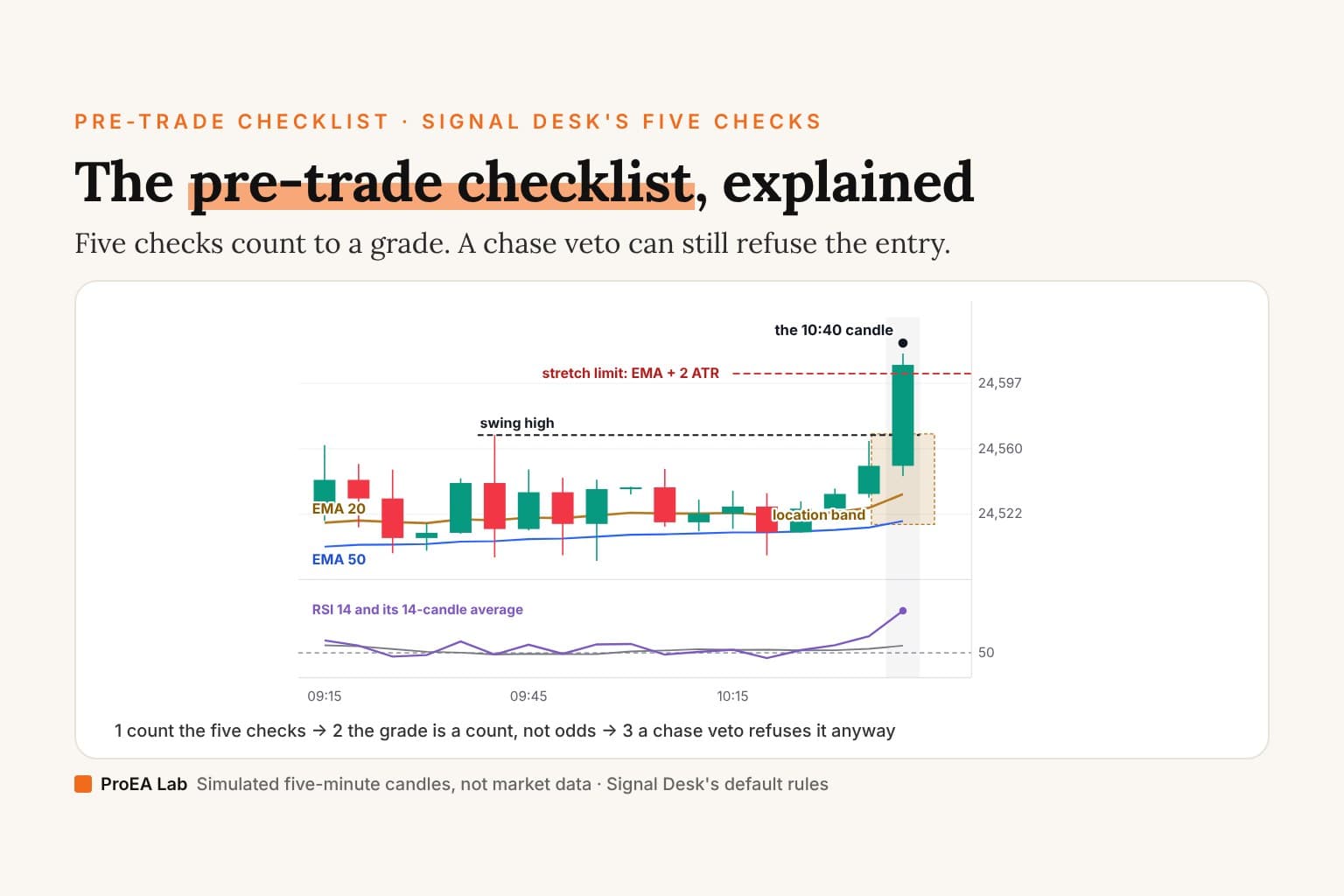
The chart below is one simulated five-minute session, read by the desk's rules as its own page's simulator runs them. Price chops around the 20 EMA, which sits just above the 50 EMA, and then a large green candle opens at 10:40 and closes through the morning's swing high. That's the candle a chaser buys. Tick the checks it passes, using the readings beside each rule, before you step through the answer.
Your ticks: 0 of 5, grade below C.
Tick each check the marked close passes, from the readings beside its rule. A is all five, B four, C three; the desk's default minimum is B. Then see the desk's count.
Simulated five-minute index candles, not market data and not a result. The rules are Signal Desk's defaults as its page's simulator runs them (long side; shorts mirror it). Readings rounded to one decimal; ATR is Wilder's 14.
| Reading on the 10:40 candle's close | Value |
|---|---|
| Open, high, low, close | 24,549.7, 24,614.1, 24,543.8, 24,607.6 |
| 20 EMA and 50 EMA | 24,533.5 and 24,518.1 |
| Supertrend (10, 3) | up |
| RSI (14) and its average | 65.6 and 52.7 |
| ATR (14) | 34.5 |
| Last confirmed swing high | 24,567.3, from the 09:40 candle |
The answer, step by step
The trigger. The desk's pullback trigger fires on this close: price came within 0.3 ATR of the 20 EMA within the last three candles, then gave a strong green close above it as RSI turned up. So the desk grades it.
- Trend: passes. Supertrend (10, 3) is up, and the 20 EMA (24,533.5) is above the 50 EMA (24,518.1).
- Momentum: passes. RSI is 65.6: above its average (52.7) and above 50.
- Structure: passes. The last confirmed swing high, 24,567.3 at 09:40, was broken by this candle's own close, and no swing low has broken since.
- Location: fails. The close is 74.1 above the 20 EMA, 2.15 ATR. The check allows 0.5 ATR below to 1 ATR above, which on this candle is 24,516.2 to 24,568.0. The close, 24,607.6, is well above the band.
- Candle: passes. The range is 70.3, 2.03 ATR, under the 2.5 limit. The body is 82% of the range (40% needed) and the top wick 9% (35% at most).
The grade: B. Four of five. That meets the default minimum of B, so the grade alone would let it through.
The limits: refused. The candle range passes (2.03 ATR against 2.5), and the three-close run passes (2.14 ATR against 3). The stretch veto doesn't: the close is 2.15 ATR above the 20 EMA, more than 2. The stretch limit sits at 24,602.6, and the close is 5.0 above it. The day's gates would all have passed: 10:40 is inside the window, no entries yet today out of 2, and the last exit was 25 candles ago, in the previous session. One veto is enough. No entry.
That's the point of the second half of the list. The candle isn't oversized by the rule, the grade meets the minimum, and the close is still too far from the average to buy. Had all five checks passed, the grade would have been A, and it would still have been a count of conditions, not the odds of a win.
Trading checklist PDF
The pre-trade checklist PDF is one A4 page: the five checks with their numbers, the grades, the three chase vetoes, the day's limits, what an A is and isn't, and a grid to tick ten trades by hand. Print it and keep it next to the screen.
The numbers on it are Signal Desk's defaults, built on a five-minute index chart. The checks are written in candles and ATR, so they read the same on a forex pair, a stock or a future, on any timeframe. For a swing trading checklist on daily candles, the same five checks apply as written; the entry window and the daily cap belong to day trading, and you'd drop or change them. None of the numbers is a recommendation for your market. Write down the ones you'll use, then test them before you trust them.
Trading checklist template (Excel)
The same checklist comes as a spreadsheet: pre-trade-checklist-v1.xlsx for Excel or Google Sheets, and pre-trade-checklist-v1.csv with the checklist's 13 lines for an app that imports a CSV. The workbook has four sheets:
- Checklist: every line above in plain numbers (the five checks, the grade rule, the three chase vetoes and the four day lines), with what an A is and isn't.
- Trades: one row per setup you consider. Type Y or N in each tick column; a dropdown offers both. Checks passed is a formula,
=IF(COUNTA(E2:I2)=0,"",COUNTIF(E2:I2,"Y")): blank until you tick, then the number of Y's among the five checks. Grade turns that count into A, B or C, so ticking the five checks gives the grade. The three veto columns read Y when the veto doesn't apply. Daily cap is a formula too: it counts the earlier rows of the same date marked ENTRY and compares them with the cap. Entry? reads ENTRY only when the grade meets your minimum and every veto and day line reads Y. - Settings: the minimum grade (B) and the daily cap (2) the formulas read, with the cooldown (6 candles) and the entry window for reference.
- Read me: how to use it.
Four example rows, marked EXAMPLE on a simulated market, show the formulas at work: the drill's 10:40 candle (grade B, no entry, the stretch veto), an A that enters, a B that enters as the day's second, and an A refused because the day's cap of 2 is used. Delete them before you start. In Google Sheets, choose File → Import → Upload and pick the .xlsx; that keeps the formulas and the dropdowns. The CSV carries the lines only, no formulas.
Is there a checklist indicator on TradingView?
Yes, several. TradingView's script search, run for checklist terms on 29 October 2026, listed dozens of open-source scripts with "checklist" in the name, such as "Sticky Notes, Checklist, To-do, Journal [algoat]" and "Trading Checklist - Sonarlab". We haven't read their code for this post, so we say nothing about what they do.
Ours is Signal Desk, an entry checklist indicator in Pine Pro Library. It computes the five checks above on every closed candle, prints the grade on each entry label, applies the vetoes and the day's limits, and draws a reference plan with a stop and 1R, 2R and 3R targets. Its full Pine source is in the library.
Signal Desk Premium uses the same entries and adds the work around them: a GET READY heads-up before the signal, a trade ticket sized from your risk, scale-outs, a daily loss lock and a 20-market Radar. In its own words: "Premium uses the same entries as the library desk. It does not promise better results; it makes the same signals easier to prepare for, size, manage, filter and act on." Its alerts, like any indicator alert, need a paid TradingView plan: TradingView's pricing page, read 29 October 2026, lists "Active technical alerts on indicators, strategies, and drawings" as ✗ on Basic and 20 on Essential.
Is there a trading checklist app?
Yes, of two kinds, and it helps to know which one you want.
A checklist app holds a list you tick by hand. Any app that keeps a list will do, and the CSV above imports into the ones that take a file. What no list app can do is read your chart: you still decide whether each line passes, and the spreadsheet does the counting for you.
The other kind reads the chart: an indicator that computes the checks on every closed candle. That is what Signal Desk does with this list, as above. If you want the result on your phone, Signal Desk Premium's alert can arrive as "a readable ticket for your phone: side, grade, entry, stop, TP1–TP3, size, risk, fees, room", which needs Essential or above, as the pricing row shows. Either way, the grade is a count of conditions, not odds.
Trading plan checklist
A trading plan and a pre-trade checklist are different documents. The plan is written once and changed rarely: what you trade, when, how much you risk and how you'll review it. The checklist runs on every trade. A trading plan checklist makes sure the plan answers each question before the first trade:
- Market and timeframe. Which symbols, on which chart.
- Hours. When you may enter, and when you stop.
- The setup. The trigger that finds a trade, the five checks that grade it, and your minimum grade.
- The limits. The chase vetoes, your cap on entries a day and the cooldown after an exit.
- Risk per trade. The most you'll lose if the stop is hit, and how the size follows from it.
- The day's loss limit. The loss after which you stop for the day: daily loss limit explains the choices.
- Exits. Where the stop goes, where the targets are, and what moves them.
- Review. When you read your record, and what result would make you change a number.
The pre-trade checklist covers items 3 and 4 on every trade, and the spreadsheet's Trades sheet keeps the record of what you ticked.
Sources
- Signal Desk's manual: /en/pine-library/signal-desk, its five checks, grades, vetoes and session defaults (Signal Desk 1.2.0), and Signal Desk Premium's page for the grade answer and the honesty line, both read 29 October 2026.
- Haynes et al., "A surgical safety checklist to reduce morbidity and mortality in a global population", N Engl J Med 2009;360:491–499, doi:10.1056/NEJMsa0810119; abstract read 29 October 2026.
- Dawes, "The robust beauty of improper linear models in decision making", American Psychologist 34(7):571–582, 1979, doi:10.1037/0003-066X.34.7.571; read 29 October 2026.
- TradingView's pricing page and its script search, read 29 October 2026.
- The drill:
src/components/blog/pre-trade-checklist/checklist-example.ts, simulated bars read by the Signal Desk engine its page's films use. - The spreadsheet:
scripts/build-pre-trade-checklist-sheet.py, from the same lines as the PDF, its formulas recalculated in LibreOffice.
Disclosure
We, ProEA Lab, build and sell Signal Desk (in Pine Pro Library) and Signal Desk Premium (in the Premium Vault). The code is AI-assisted. The drill's candles are simulated: not a market, and not a result. A grade is a count of conditions, not a forecast. Nothing here is financial advice. Trading involves risk.
Frequently asked questions
What is a pre-trade checklist?
A short list of conditions you check, in the same order, before every entry, with a rule for what happens when one fails. Ours has two parts: five setup checks that count to a grade (trend, momentum, structure, location and candle), then limits that can refuse the entry whatever the grade (three chase vetoes, a daily cap of 2 entries, a 6-candle cooldown and an entry window).
What should be on a checklist before entering a trade?
The conditions your setup needs, each written so you can answer yes or no from the chart. Signal Desk's five are a trend that agrees, momentum that agrees, a structure break that agrees, a close near the 20 EMA, and a strong candle that isn't oversized. Then the things that refuse a trade outright: a candle over 2.5 ATR, a close over 2 ATR from the 20 EMA, a three-close run over 3 ATR, and the day's cap.
What is an A+ setup in trading?
Trader slang for a trade where everything on your list agrees. On Signal Desk that is an A: all five setup checks. B is four and C is three. An A is a count of conditions present on the close, not a probability, and it still has to pass the chase vetoes and the day's limits before it is an entry.
Does an A grade mean the trade will win?
No. A grade counts the checks that agreed when the signal fired; it says nothing about how likely the trade is to work. Whether A beat B on one real chart is a question you answer by measuring, with costs on, on your own market.
Why use a checklist instead of judging each trade?
Because a written list gets the same steps done every time. In surgery, a 19-item checklist was followed by deaths falling from 1.5% to 0.8% in a before-and-after study, which says nothing about trading. And a plain count of checks, each weighted the same, is a respectable way to combine them: Dawes found equal weights quite robust.
Is there a trading checklist PDF?
Yes. The one-page PDF linked from this post prints the five checks, the grades, the three chase vetoes and the day's limits, with tick boxes for ten trades.
What is a day trading checklist?
A pre-trade checklist with the day's limits added: when you may enter, how many entries a day, and how long to wait after an exit. Signal Desk's defaults are entries from 09:30 to 14:45 India time, at most 2 entries a day and a 6-candle cooldown.
Is there a trading checklist template in Excel?
Yes. This checklist comes as an Excel workbook: the five checks, the three chase vetoes and the day's limits on one sheet, and a sheet to tick each setup, where a formula counts the checks into a grade and says whether every limit allows an entry. It opens in Google Sheets with its formulas, and a CSV of the checklist's 13 lines sits beside it.