Short answer: "trading signal" means two different things. A signal you run is a rule: an indicator, script or strategy that marks a buy or a sell on your own chart when its conditions are met, best judged on closed candles. A signal you're sent is a tip: a Telegram channel or a paid service telling you what to trade. Most "buy sell signal software" is the first kind, an indicator on a charting platform. It knows the candles it reads and nothing after them, and an arrow on its own isn't a trade: it needs a stop, a size and an exit. In India, buy and sell calls given for a fee on securities listed on a stock exchange are a regulated service: SEBI's Research Analysts Regulations list "making 'buy/sell/hold' recommendation" and "providing trading calls" among research services "with respect to securities that are listed or proposed to be listed in a stock exchange", and no one may act as a research analyst without registering with SEBI.
This post takes the two meanings apart, shows how a signal can print and vanish on a live candle (with a drill you can step through), works out by hand what turns an arrow into a trade, and quotes what SEBI's own regulations and circulars say. Every outside fact was read on 29 October 2026 from its own page.
What are trading signals?
Two things share the name, and they work differently:
| A rule you run | A tip you're sent | |
|---|---|---|
| What it is | An indicator, script or strategy on your chart | A message: buy this, here, now |
| Who decides | The rule, on the candles it reads | Whoever sends it |
| Can you check it | Yes: read the rule or the code, and see it on history | Only by following it |
| When it fires | When its conditions are met, best on a closed candle | When the sender sends |
| In India | Your own rule on your own chart; orders sent automatically through a broker's API come under SEBI's retail algo framework | Sold for a fee on listed securities, a research analyst's service under SEBI's regulations |
A rule is something you can take apart. You can read what it calls a buy, see every signal it gave on history, and decide whether you'd take them. A tip arrives with none of that: you know what the sender says, not why, and not what they said last month that didn't work.
This post is mostly about the first kind. The SEBI section near the end is about where the second kind stands.
What is a buy signal in stocks?
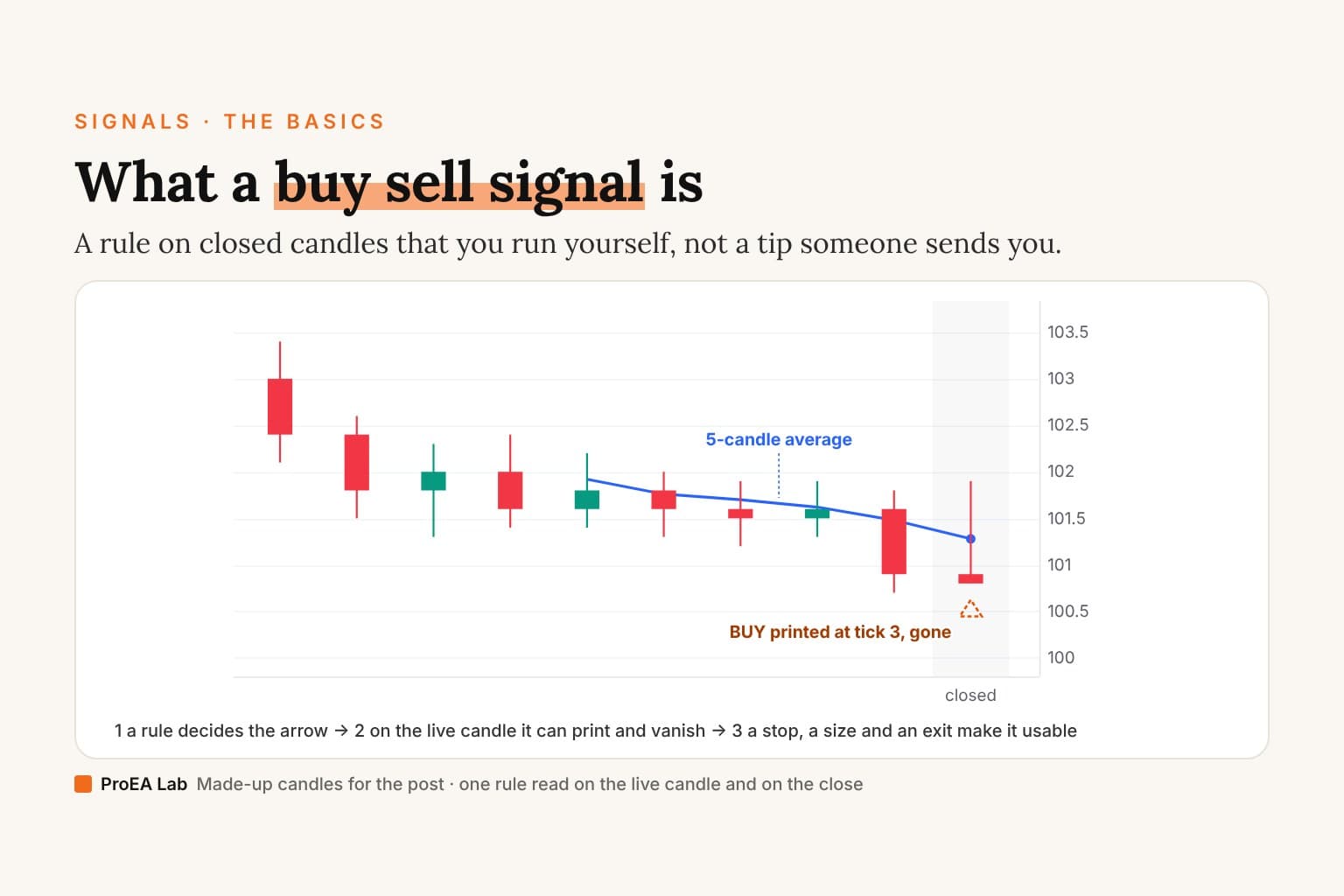
A buy signal is the candle where a rule's conditions for a long trade are met. "BUY when the close crosses above its 5-candle average" is a rule; the candle where it happens is the signal. A sell signal mirrors it, and depending on the tool it means either "close the long" or "open a short", so read which one yours means.
What is a signal indicator?
An indicator that turns its reading into marks. A moving average draws a line; a signal indicator built on it marks the candle where price crosses the line, with an arrow, a label or a change of colour, and usually offers an alert on the same condition. The arrow is the rule's output. Everything you need to judge it is in the rule.
Buy sell signal software in India
"Signal software" is almost always an indicator running on a charting platform: a TradingView script, or one of the indicators built into a broker app's charts. The broker apps differ in what they let you add. Zerodha, for one, says Kite "uses a built-in library of indicators instead of a public one", so some indicators found on tradingview.com aren't available on Kite's charts. Each app's answer, in its own words, is in buy sell indicator in Zerodha Kite, Angel One, Dhan, Groww and Upstox.
What an indicator can know:
- The candles of the chart's symbol and timeframe, up to the one forming now.
- Other symbols and timeframes its code asks for. TradingView caps it: "A script can use up to 40 unique calls to the functions in the request.*() namespace, or up to 64 unique calls if the user has the Ultimate plan".
- The settings you type in.
What it can't know:
- The next candle. A script that seems to know it on history is reading the future by mistake. TradingView's manual calls "Scripts that leak future information into the past" an "Unacceptable" kind of repainting.
- Your trades, unless you type them in. Our own Radar says so on its page: "It doesn't know your open trade or today's lock."
- Data it doesn't request. An index-chart signal isn't an option chain. Our library desk's option labels say the mapping "does not read an option chain, premiums, Greeks or available expiries."
So the honest description of any signal software is its rule, the data it reads and when it decides. A page that sells one without those three is selling the arrows.
Buy sell indicator app
On a phone, the usual route is TradingView: add the indicator on the chart, then set an alert on its buy or sell condition. TradingView's help says "Alerts work seamlessly on the web version, as well as in the desktop and mobile apps", and one way an alert reaches you is an "App notification".
That alert needs a paid plan. TradingView's pricing page, read on 29 October 2026, lists "Active technical alerts on indicators, strategies, and drawings" as ✗ on Basic, 20 on Essential, 100 on Plus, 400 on Premium and 1,000 on Ultimate. Basic still runs the indicator; it just can't alert you when the indicator fires.
"Auto" buy sell signal software is the same indicator with a bridge after it. TradingView sends the alert to a webhook, and something on the other side (your broker's own service, or a program you run) places the order. Webhooks start at Essential too ("Webhook notifications": ✗ on Basic, ✓ from Essential). In India, an automated order that reaches your broker through its API comes under SEBI's retail algo rules, quoted below.
Repainting: the buy signal that disappears
TradingView's Pine Script manual: "We define repainting as: script behavior causing historical vs realtime calculations or plots to behave differently." By that definition, it adds, "our estimate is that more than 95% of indicators in existence exhibit some form of repainting behavior."
The kind that hurts a signal is the live candle. While a candle forms, its close is just the latest price, so a rule read on every tick can be true at one tick and false at the next. The arrow prints, then vanishes. Reload the chart and history keeps only each candle's final state, so the arrow you saw, and maybe traded, is gone from the record.
Step through it. The rule is "BUY when the close crosses above its 5-candle average", read two ways: on every tick of the live candle, as most indicators do, and only once the candle has closed.
- Alert on the live reading, Once Per Bar:
- went out at tick 3, 101.6
- Alert on the close reading:
- waits for the close
Tick 3 of 8: price 101.6, average 101.44. The live reading prints BUY.
The close reading waits: the candle has 5 ticks to go. An alert on the live reading set to Once Per Bar has already gone out, at 101.6.
Made-up prices for the explainer, not market data and not a result. The live reading is how an indicator behaves when it decides on the forming candle; the close reading is the same rule with Pine's barstate.isconfirmed.
The arithmetic, by hand. The four closes before the live candle are 101.6, 101.5, 101.6 and 100.9, which sum to 405.6. The live average is (405.6 + price) ÷ 5, so price sits above its own average whenever 4 × price is more than 405.6: above 101.4.
- Tick 3, price 101.6: the average is (405.6 + 101.6) ÷ 5 = 101.44. Price is above it, and the last candle closed at 100.9, under its average of 101.48, so the cross is on. The live reading prints BUY. An alert on it set to fire "Once Per Bar" goes out now, at 101.6.
- Tick 6 on the fading path, price 101.3: the average is 101.38. Price is back under it, and the BUY disappears.
- The close, 100.8: the average is 101.28. No cross, no BUY on either reading. Reload the chart and the candle has no arrow, though an alert went out at tick 3.
- On the holding path, the candle closes at 102.0 over an average of 101.52, and both readings say BUY. The live one said it at 101.6, the close reading at 102.0: waiting cost 0.4 and bought a mark that can't vanish.
TradingView's manual on that trade-off: "There is no panacea; avoiding this type of repainting always entails waiting for confirmed information, which means the trader must sacrifice immediacy to achieve reliability."
How to check a buy sell signal for repainting
TradingView suggests better questions than "does it repaint?". From its manual:
- "Does the script calculate/display in the same way on historical and realtime bars?"
- "Do alerts from the script wait for the end of a realtime bar before triggering?"
- "Do signal markers shown by the script wait for the end of a realtime bar before showing?"
- "Does the script plot/draw values into the past?"
- "Do the script's request.security() calls leak future information into the past on historical bars?"
Without reading code: watch it live for a session, note each arrow and when it appeared, then reload and compare; our 20-minute repaint audit walks through it. With the code open: look for barstate.isconfirmed, which makes a signal wait for the close; lookahead_on without a [1] on the value, which reads a higher-timeframe candle before it closes; and a negative offset, which draws a value before it was known. Our code read of 11 buy sell scripts does exactly this, script by script.
Whatever the script does, an alert set to "once per bar close" can't fire on a live candle that later changes. TradingView's alert settings offer it as one of four triggers: "only once, every time, once per bar close, or once per minute".
What makes a buy sell signal usable
An arrow says "now". It doesn't say where you're wrong, how much to buy, or when to get out, and those decide what the trade does to your account.
The stop. Where the trade is wrong. Without one, there's no way to size the trade, and no defined loss.
The size, from the money you'll risk. The rule our Premium ticket uses: "Risk ÷ (stop distance × money per point), rounded down."
- A stock: you'll risk ₹1,000. The signal says BUY at ₹500 with a stop at ₹492, so each share risks ₹8. 1,000 ÷ 8 = 125 shares. The targets at 1R, 2R and 3R sit at ₹508, ₹516 and ₹524.
- Nifty futures: you'll risk ₹2,000, and the signal's stop is 40 points away. NSE's market lots file, read on 29 October 2026, lists 65 for every NIFTY contract, so a point is worth ₹65 a lot and one lot risks 40 × 65 = ₹2,600. 2,000 ÷ 2,600 = 0.77, rounded down to 0 lots. The signal is real; at that risk, you can't take it. Most signal software never tells you that.
The stock position size calculator and the Nifty position size calculator do these sums for you; the Nifty one also sizes options from the premium.
The exit. A target, a trail, an opposite signal, or a time. Our library desk's plan: "TP1 moves the stop to entry; TP2 moves it to TP1 and starts an ATR trail; TP3 ends the plan." Taking part off at the first target is its own decision; partial take profit on TradingView covers the three ways to do it there.
Two more limits make a signal livable over a day: how many you'll take, and when the day is over. Our pre-trade checklist puts all of it on one page.
Is signal trading legit? What SEBI says
Running your own rule on your own chart is analysis. Selling buy and sell calls is a regulated business in India, and orders automated through a broker's API come under SEBI's rules too. Below is what SEBI's own regulations and circulars say, read on SEBI's website on 29 October 2026 and quoted with their dates. We're not lawyers and this isn't legal advice; whether a particular service is inside these rules is SEBI's call.
Who may give buy and sell calls for a fee
The SEBI (Research Analysts) Regulations, 2014, as amended up to 10 October 2026, define a "research analyst" as "a person who, for consideration, is engaged in the business of providing research services". Research services include, among others:
- "making 'buy/sell/hold' recommendation";
- "giving price target or stop loss target";
- "providing trading calls".
"Trading calls" means "intraday, ultra-short duration, non-delivery based (other than hedging) recommendation or any recommendation related to securities that are not personalized or investor specific." And regulation 3(1): "no person shall act as a research analyst or research entity or hold itself out as a research analyst unless he has obtained a certificate of registration from the Board under these regulations".
The other route is the SEBI (Investment Advisers) Regulations, 2013, as amended up to 25 November 2025. "Investment advice" there covers "advice relating to investing in, purchasing, selling or otherwise dealing in securities", with a proviso: "trading calls shall not be considered as investment advice for purpose of these regulations." So paid trading calls sit with research analysts, and personal advice for a fee with investment advisers, each needing its own registration.
SEBI publishes both lists. On 29 October 2026 its Research Analyst list showed 2,327 records and its Investment Adviser list 1,065, each searchable by name, trade name or registration number. If someone charges you for calls, their name should be on one of them.
Finfluencers and unregistered tips
Since 29 August 2024, SEBI's amended regulations bar persons regulated by SEBI, the market infrastructure institutions (stock exchanges, clearing corporations and depositories), and their agents from any direct or indirect association with a person who:
- "provides advice or any recommendation, directly or indirectly, in respect of or related to a security or securities, unless the person is registered with or otherwise permitted by the Board to provide such advice or recommendation; or"
- "makes any claim, of returns or performance expressly or impliedly, in respect of or related to a security or securities, unless the person has been permitted by the Board to make such a claim."
SEBI's circular of 29 January 2025, updated on 8 May 2026, spells out "association": "transaction involving money or money’s worth or referral of a client or interaction of information technology systems or any other association of similar nature or character, by any name called." So a broker can't pay an unregistered tipster, take referrals from one, or plug into one's systems.
Education is carved out, with a line drawn since 8 May 2026: a person engaged solely in education "should not be using the market price data of the preceding thirty days to speak/talk/display the name of any security including using any code name of the security in his/her talk/speech, video, ticker, screen share etc. indicating the future price, advice or recommendation related to security or securities." Before that update, the window was three months.
Retail algo trading: strategies and APIs
SEBI's circular "Safer participation of retail investors in Algorithmic trading", dated 4 February 2025, sets the rules for algo orders that reach a broker through its API:
- The broker answers for it. "brokers shall be the principal while any algo provider or fintech/vendor (hereinafter referred to as “Algo Provider”) shall act as its agent".
- Every algo order is tagged. "All algo orders originating/flowing through Application Programming Interface (API) extended by brokers to algo providers, shall be tagged with a unique identifier provided by Stock Exchange."
- No open APIs. Brokers shall "not permit open APIs and allow access only through a unique vendor client specific API key and static IP whitelisted by the broker", and "authenticate access to API through two factor authentication".
- Your own algo, if you write one: "Algos developed by tech-savvy retail investors themselves, using programming knowledge, shall also be registered with the Exchange, through their broker, only if they cross the specified order per second threshold." The threshold is set by the brokers' standards forum with the exchanges; we didn't find it on SEBI's site, so we don't quote a number. Such an algo may be used for your family, "but not for other investors".
- White box and black box. Algos "where logic is disclosed and replicable" are white box; where "the logic is not known to the user and is not replicable", black box, and for those the provider shall "Register as a Research Analyst and maintain a detailed research report for each such algo".
A later circular, of 30 September 2025, moved the start: brokers "who are ready with the required systems shall go live w.e.f. October 01, 2025", and "W.e.f. April 01, 2026, algo framework specified in circular dated February 04, 2025 along with implementation standards and detailed operational modalities (issued by exchanges) will be applicable for all stock brokers."
What this means for a TradingView signal: an alert that only tells you is not an order. An alert that a bridge turns into an order through your broker's API is the route this framework is about, so the broker decides how it's allowed. Dhan, for example, offers webhooks for TradingView alerts, and Zerodha's Kite Connect FAQ says "You must configure a static IP address to place orders via the Kite API from 1 April 2025." Ask your broker how its API handles algo orders before you automate anything.
SEBI warned about the sales pitch years earlier. A June 2022 press release: "Investors are cautioned that these platforms are unregulated and thus there is no investor grievance redressal mechanism covering their activities." And a September 2022 circular says brokers offering algo trading "shall not: 4.1.1. directly or indirectly make any reference to the past or expected future return/performance of the algorithm".
100% accurate buy sell signal software
No honest indicator can claim to be 100% accurate. TradingView's own script publishing rules set the bar for any author: "Do not make unrealistic or unsubstantiated claims about your script's performance, whether on TradingView or elsewhere. If you make any claims about trading performance, signal accuracy, statistical reliability, etc., substantiate those claims clearly in your description. If you cannot substantiate a claim, it does not belong in your publication."
The SEBI circular above says the same thing to brokers about algorithms' returns. A page selling a signal on its hit rate is telling you about the past, chosen by the seller. A rule you can read and check on history tells you more. When we asked that of our own signals, on one Nifty chart with costs on, we wrote up everything we measured, including the parts that made it worse: we graded the signals, then tested the grade.
Signal Desk Premium: a tool you run, not a tip
We build signal software, so here is what ours is, in its own words.
Signal Desk is the rule: an entry checklist indicator in Pine Pro Library ($49 once, every library desk with its Pine source). It grades five checks on a pullback or breakout and draws a stop and targets at 1R, 2R and 3R. On repainting, its page says: "Entries commit on confirmed candles."
Signal Desk Premium, $49 once, keeps those entries and adds the work this post says a signal needs: a heads-up before the signal, a trade ticket that sizes from your risk ("Risk ÷ (stop distance × money per point), rounded down."), scale-outs ("Half at TP1 by default, then the stop moves to entry. The rest runs to TP3, trailing after TP2."), a daily lock ("By default the day locks at −2R net"), and a Radar of 20 markets with one alert, NSE India among its ready lists. On repainting, its page: "Heads-ups, signals, stop moves and exits are decided on closed bars, and each higher frame is read from its last closed bar."
It's software you run on your own chart, with your settings, on the market you open. It sends no tips, and its page says: "The scripts never place orders." If you connect a bridge to its alerts, the bridge places orders through your broker, under your broker's rules. Its alerts need TradingView's Essential plan or above, by the pricing row quoted earlier.
Premium uses the same entries as the library desk. It does not promise better results; it makes the same signals easier to prepare for, size, manage, filter and act on.
Sources
- SEBI: the Research Analysts Regulations, 2014 (amended up to 10 October 2026); the Investment Advisers Regulations, 2013 (amended up to 25 November 2025); the registered Research Analyst and Investment Adviser lists; the circulars on association with persons engaged in prohibited activities (29 January 2025, updated 8 May 2026), safer participation of retail investors in algorithmic trading (4 February 2025), its extension of timeline (30 September 2025) and performance claimed by unregulated algo platforms (2 September 2022); and press release PR No.20/2022 (10 June 2022). All read 29 October 2026.
- TradingView: the Pine Script manual's Repainting, Alerts and Limitations pages; the help pages Introduction to TradingView alerts, Learn how to configure alerts and Script publishing rules; and the pricing page's alert and webhook rows. Read 29 October 2026.
- NSE's market lots file, Zerodha's support page on TradingView indicators in Kite and its Kite Connect FAQ, read 29 October 2026.
- The drill:
src/components/blog/buy-sell-signal/live-candle.ts, nine made-up closed candles and two made-up paths for the live one.
Disclosure
We, ProEA Lab, build Signal Desk and Signal Desk Premium and sell them. The code is AI-assisted. The drill's candles are made up to show how a rule behaves on a live candle; they are not a market and not a result. SEBI's, TradingView's, NSE's and the brokers' words are quoted from their own pages as read on 29 October 2026, and can change. Nothing here is legal or financial advice. Trading involves risk.
Frequently asked questions
What are trading signals?
Two different things share the name. One is a rule you run yourself: an indicator, script or strategy that marks a buy or a sell on your own chart when its conditions are met, best judged on closed candles. The other is a tip someone sends you, in a Telegram channel or a paid signal service, saying what to buy or sell. A rule you can read and test; a tip you can only follow.
What is a buy signal in stocks?
The moment a rule's conditions are met for a long trade, such as the close crossing above a moving average. On its own it is only an entry. It becomes a trade you can take when it comes with a stop, a size worked out from the money you're willing to lose, and an exit.
What is buy sell signal software?
Usually an indicator on a charting platform such as TradingView, or in a broker app's own charts. It reads the candles of the chart's symbol, and any other symbol or timeframe its code requests, and marks a buy or a sell when its rule is met. It can't know the next candle.
Is there a buy sell indicator app?
TradingView's alerts work on its website and in its desktop and mobile apps, so an alert on an indicator's buy or sell can reach your phone as an app notification. Alerts on indicators need TradingView's Essential plan or above: its pricing page shows none on Basic and 20 on Essential. Indian broker apps' own charts mostly offer their built-in indicators.
Does a buy sell signal repaint?
It can. TradingView defines repainting as script behavior causing historical vs realtime calculations or plots to behave differently. An indicator that decides on the live candle can print a buy and take it back before the candle closes. Use one that waits for the close, or set its alert to fire once per bar close.
Who can give buy sell tips for a fee in India?
A research analyst registered with SEBI. SEBI's Research Analysts Regulations count making buy, sell or hold recommendations, giving a price target or stop loss target, and providing trading calls as research services, with respect to securities listed or proposed to be listed in a stock exchange, when done for consideration, and say no person shall act as a research analyst without SEBI's certificate of registration. SEBI's website lists every registered research analyst.
Is there 100% accurate buy sell signal software?
No honest one can claim it. TradingView's script publishing rules say an author must substantiate any claim about signal accuracy, and that a claim which can't be substantiated does not belong in the publication. SEBI bars brokers that offer algo trading from referring to an algorithm's past or expected returns.
Is Signal Desk Premium a signal service?
No. It is a set of TradingView scripts you run on your own chart: the library desk's entries with a heads-up before the signal, a trade ticket sized from your risk, scale-outs, a daily lock and a 20-market Radar. It sends no tips, places no orders and promises no better results.