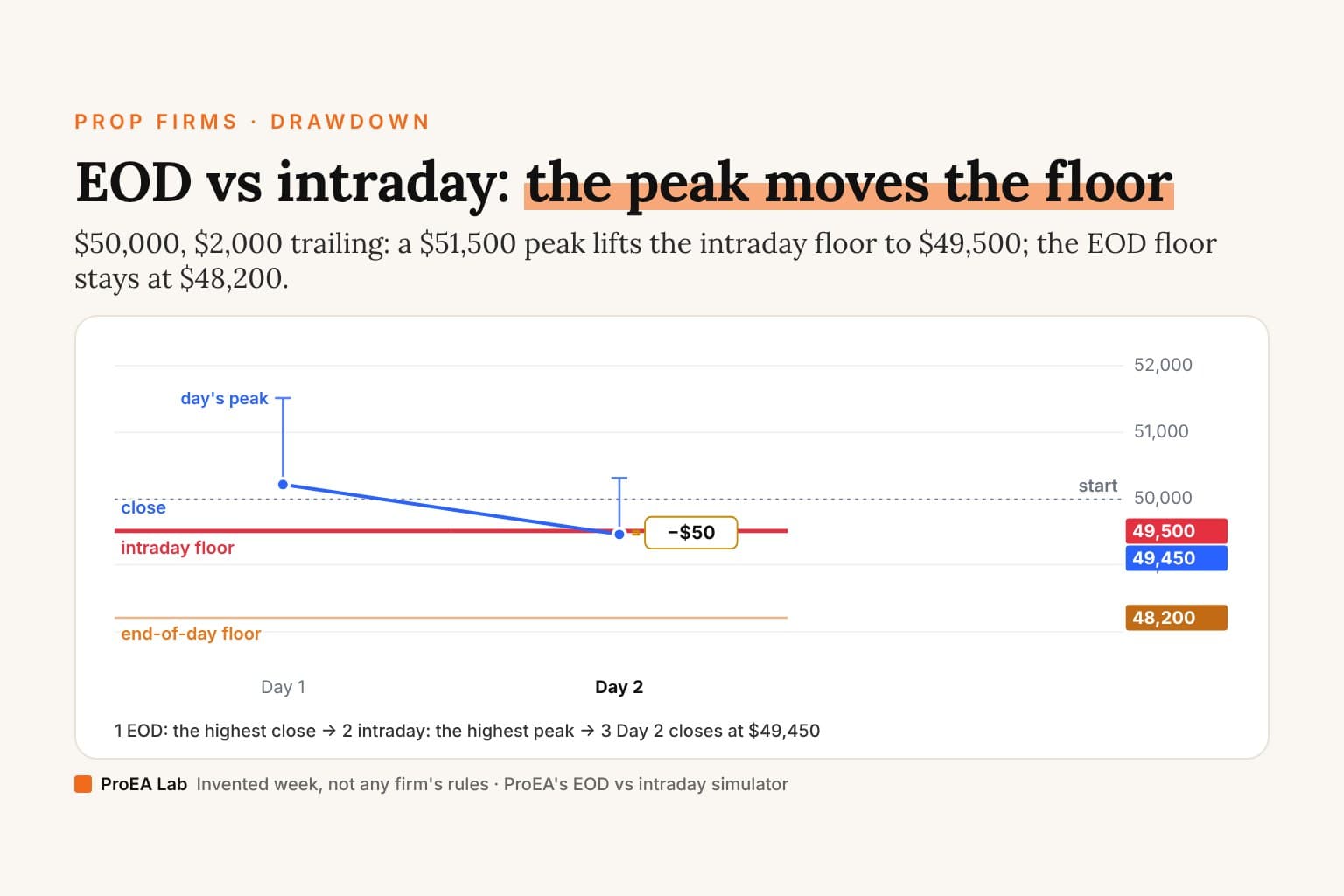
Short answer: an EOD (end-of-day) drawdown trails your highest closing balance and moves once a day; an intraday trailing drawdown trails the highest equity you reach, open profit included, the moment it prints. On a $50,000 account with a $2,000 allowance, a day that runs to $51,500 and closes at $50,200 leaves the end-of-day floor at $48,200 and the intraday floor at $49,500. The intraday floor is the one that ends accounts on a give-back day.
Both are trailing drawdowns: the floor follows you up and never comes down. The difference is what it follows.
The same week, two floors
Day 4: a close at $52,400 would lift the floor past $50,100, so it stops there for good. Room: $2,300.
Illustrative balances, not market data, and not any firm's rules: a made-up $2,000 trailing drawdown that stops at the starting balance plus $100, a lock some futures firms use.
Rule: floor = the highest closing balance − $2,000, never above $50,100. It moves once a day, at the close.
Read as text
- Day 1: the day runs to $51,500 but closes at $50,200. Only the close counts: the floor moves to $48,200.
- Day 2: a losing close at $49,450. The floor never moves down: it stays at $48,200, $1,250 away.
- Day 3: a new highest close, $51,200, moves the floor to $49,200.
- Day 4: a close at $52,400 would lift the floor past $50,100, so it stops there for good. Room: $2,300.
One invented week on a $50,000 account with a $2,000 trailing drawdown that stops at $50,100, a lock some futures firms use. The trades are the same in both tabs; only the rule changes.
| Day | Close | Day's peak | EOD floor | Room at the close | Intraday floor | Room at the close |
|---|---|---|---|---|---|---|
| Day 1 | $50,200 | $51,500 | $48,200 | $2,000 | $49,500 | $700 |
| Day 2 | $49,450 | $50,300 | $48,200 | $1,250 | $49,500 | −$50, breached |
| Day 3 | $51,200 | $51,400 | $49,200 | $2,000 | — | — |
| Day 4 | $52,400 | $52,600 | $50,100, stopped | $2,300 | — | — |
A static floor on the same account would sit at $48,000 all week: $50,000 minus $2,000, whatever happens. That rule and its trade-offs are in static vs trailing drawdown.
What is EOD drawdown?
The floor is your highest closing balance minus the allowance, worked out once a day at the close. Day 1 runs to $51,500, but only the $50,200 close counts, so the floor moves to $48,200. Day 2 loses and the floor stays put: a trailing floor never moves down. Day 3 closes at a new high, $51,200, and the floor moves to $49,200. On Day 4 a close at $52,400 would lift it to $50,400, past the $50,100 lock, so it stops at $50,100 for good.
End of day describes when the floor moves, not always when it's checked. Topstep's Maximum Loss Limit trails end-of-day closes and locks at your starting balance, but open losses count against it in real time (Topstep's trailing drawdown, read 18 October 2026).
What is intraday trailing drawdown?
The floor is the highest equity you've reached minus the allowance, open profit included, and it moves the moment a new peak prints. Day 1's $51,500 peak lifts it to $49,500, though the trade gave most of it back and closed at $50,200: $700 of room, where the end-of-day floor leaves $2,000. Day 2 closes at $49,450, $50 under that floor, and the account is over. Under an end-of-day trail the same close has $1,250 of room.
That's the whole risk of an intraday trail: a winning trade you don't close can raise your floor and then take the account when it turns.
Which firms use which
From our firm guides, each checked against the firm's own pages on the date shown:
| Firm and account | Floor | Stops at | Read |
|---|---|---|---|
| Topstep Trading Combine | End of day; open losses count in real time | Your starting balance | 18 Oct 2026 |
| Apex | End of day or intraday, by account type | Start + $100 on a PA | 22 Oct 2026 |
| Take Profit Trader | Test: end of day; PRO: intraday peak, open profit included | Your starting balance | 17 Oct 2026 |
| Lucid Trading | LucidPro, LucidFlex and LucidDirect: end of day. LucidDaily funded: intraday | Start + $100 | 20 Oct 2026 |
| FTMO | 2-Step: static. 1-Step: trails the highest 00:00 balance. Instant: closed-balance highs, intraday | — | 8 Oct 2026, Instant 18 Oct |
| FundedNext Stellar | 2-Step and 1-Step: static. Instant: trails the highest balance | Instant: the initial balance | 17 Oct 2026 |
Rules change. Read your account's current rulebook before you trade on any of these.
Balance-based vs equity-based drawdown
A balance-based floor counts closed trades only; an equity-based floor counts the open P&L too. FTMO's Instant account trails closed-balance highs intraday, so an open profit doesn't lift its floor until you close it. Take Profit Trader's PRO account trails the intraday peak with open profit included, so it does. Two accounts with the same "intraday trailing" label can treat the same open trade differently.
The daily loss limit beside them
The daily loss limit is a separate line, measured from each day's starting balance and reset every day at the firm's time: 00:00 CE(S)T at FTMO, 00:00 server time at FundedNext. The maximum drawdown doesn't reset with the day. Either can end the account first.
From the tracker spreadsheet's example: a $100,000 account with a static $90,000 floor and a $5,000 daily limit starts a day at $101,800, so that day's floor is $96,800. The day's low, $96,500, breaks it by $300, while the static floor is still $6,500 away.
The deep version, as a PDF
The Prop Firm Payout Playbook
Every rule between a funded account and its first payout, for 16 firms, and a plan for staying inside them.
- 16 firms' drawdown, daily loss, consistency, target and payout rules, each from our dated reading of the firm's own pages, plus the open-loss guards that cut the split and can end funded accounts
- The three drawdown floors and the daily limit, worked to the dollar, so you always know which line ends the account
- The consistency math in one line, and the day cap that, if you finish on target, keeps a big day from delaying your payout
One payment, instant download. Refund within 7 days if you haven't downloaded it.
Or get both: Toolkit + Playbook, $39 (separately $48)
The Prop Firm Challenge Toolkit (Pine indicator) and The Prop Firm Payout Playbook (PDF guide) in one ZIP, one payment. Refund within 7 days if you haven't downloaded it.
Track yours
- EOD vs intraday drawdown simulator: type each day's peak, low and close, and see both floors, the lock and the first breach.
- Prop firm challenge tracker: the same floors in Excel or Google Sheets, one row a day, with the daily loss limit beside them.
- Prop Firm Challenge Toolkit: ours, $29 once. It shows the daily loss and drawdown buffers on your TradingView chart, static, end-of-day or intraday, from the balance you type. It can't read your account, and its trailing floor follows the balance you type, not your account's history: your firm's dashboard has the final word.
Use this animation on your site.
Frequently asked questions
What is EOD drawdown?
An end-of-day trailing drawdown: the floor sits a fixed amount under your highest closing balance and moves once a day, at the close, never down. Many futures firms stop it at a lock. On a $50,000 account with a $2,000 allowance, a day that runs to $51,500 but closes at $50,200 moves the floor to $48,200: only the close counts.
What is intraday trailing drawdown?
A floor that trails the highest equity seen, open profit included, the moment it prints. The same $50,000 day that runs to $51,500 lifts it to $49,500, although the day closes at $50,200: $700 of room left, where the end-of-day floor leaves $2,000.
Is EOD or intraday trailing drawdown better?
For the trader, end-of-day: open profit you don't bank doesn't move the floor. In the example week, Day 2 closes at $49,450, under the $49,500 intraday floor, so the account is over; the end-of-day floor is $48,200, $1,250 away. Firms with an end-of-day floor may still count open losses against it during the day, so it isn't a free pass.
Does an EOD drawdown count open losses during the day?
It can. Topstep's Maximum Loss Limit trails end-of-day closes, but open losses count against it in real time (Topstep's pages, read 18 October 2026). End of day describes when the floor moves, not when it's checked: check your firm's wording.
What is the difference between balance-based and equity-based drawdown?
Balance-based counts closed trades only; equity-based includes the open P&L. FTMO's Instant account trails closed-balance highs intraday, while Take Profit Trader's PRO account trails the intraday peak with open profit included (both from their rules pages, read 18 and 17 October 2026). The same trade can move one floor and not the other.
Does the daily drawdown reset?
The daily loss limit does: it's measured from each day's starting balance and resets at the firm's time, 00:00 CE(S)T at FTMO and 00:00 server time at FundedNext. The maximum drawdown doesn't reset with the day; it only holds or, if it trails, moves up, until an event your rulebook names, such as a payout on some accounts.
What is the difference between the daily loss limit and the max drawdown?
The daily loss limit caps one day's loss from that day's start; the max drawdown is the account's lifetime floor. Either can end the account first. On a $100,000 account with a static $90,000 floor and a $5,000 daily limit, a day that starts at $101,800 has a $96,800 daily floor: a low of $96,500 breaks it by $300 while the max floor is still $6,500 away.