55 is Hull Suite's default; its own label says 55 is "for swing entry".
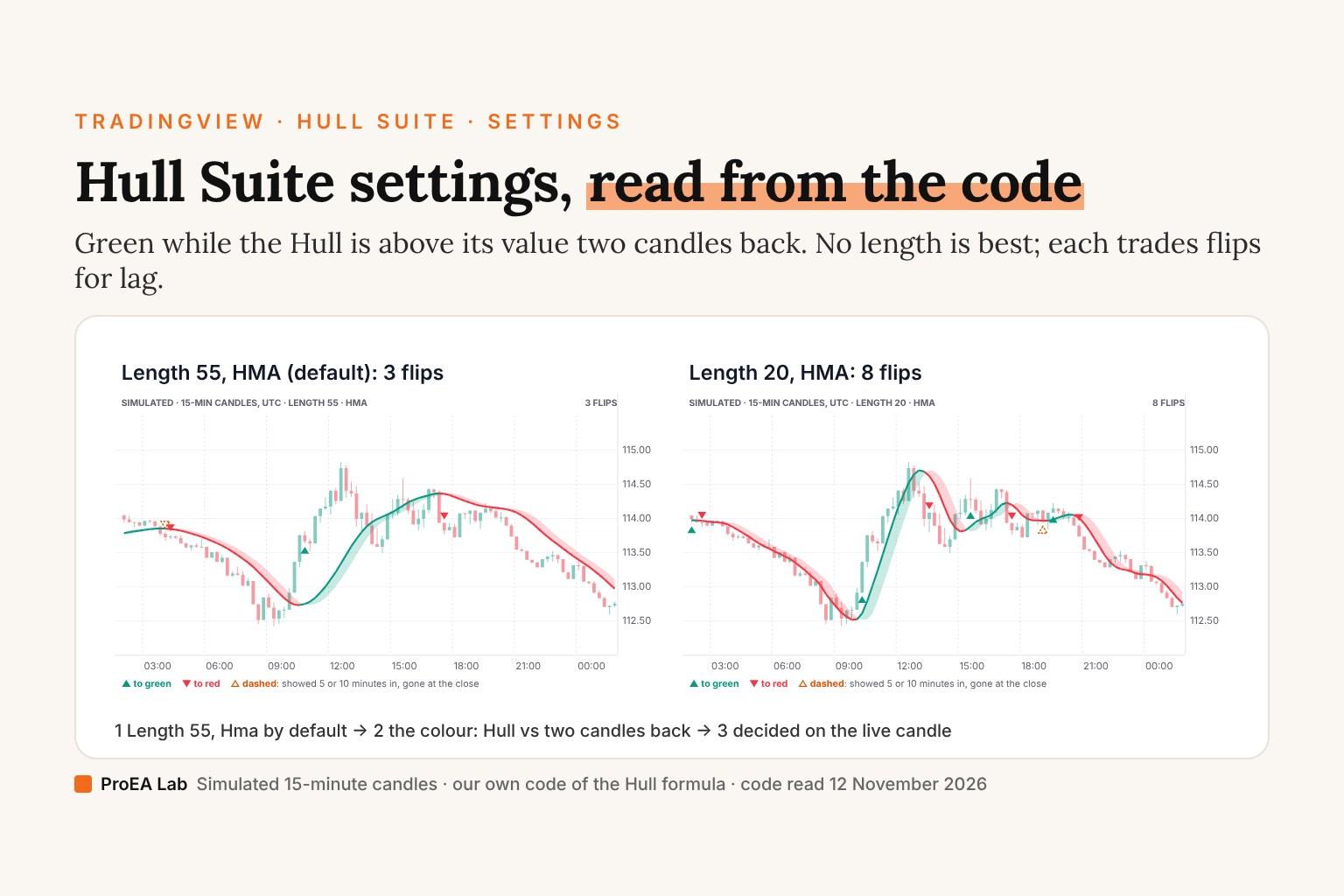
Length 55, HMA: 3 colour flips in 24 simulated hours.
The first flip is on the 04:15 candle's close, to red. 1 more flip showed 5 or 10 minutes into a candle and was gone at its close (dashed). The same candles and variation at Length 20: 8, 100: 2, 180: 2.
Simulated 15-minute candles, not market data: a window of the seeded market our structure films use. The first 296 back-to-back 15-minute candles of the simulated market (200 to warm the longest length up, 96 shown) whose shown candles span no more than 14 times their median high-to-low range, so each candle shows at the chart's scale, and in which, at Hull Suite's defaults (Length 55, HMA), the shown candles carry 3 to 10 colour flips and at least one flip that showed 5 or 10 minutes into a candle and was gone at its close; Length 20 gives more flips than 55, Length 180 fewer, and EHMA and THMA at Length 55 each give a different count from HMA's. The band is computed by our own code from Alan Hull's published formula and its EMA and triple variants, with the colour rule the post reads in Hull Suite's code; THMA gets half the Length, as the post says Hull Suite passes it. It isn't Hull Suite's code. Live readings are taken 5 and 10 minutes into each candle, not on every price update, so a real chart can show more. The flip count shows the mechanics, not which setting is better: no trades and no costs are counted.
Read as text: the flips at Length 55, HMA
- A flip to red showed 10 minutes into the 04:00 candle and was gone at its close (dashed).
- To red at the 04:15 candle's close: the Hull, 113.840, against 113.848 two candles back.
- To green at the 10:45 candle's close: the Hull, 112.744, against 112.734 two candles back.
- To red at the 17:30 candle's close: the Hull, 114.355, against 114.355 two candles back.
What we read
On 12 November 2026 we searched TradingView's scripts for "hull suite" and "hull": 58 scripts with Hull in the name, 52 of them open source, 5 protected and 1 invite-only. The most boosted is InSilico's Hull Suite. We read its full source, 52 lines of Pine v4, and the next nine most-boosted open-source Hull scripts. Line numbers below are the script's own, as TradingView served it that day. We read code; we didn't measure how any setting trades.
InSilico's eleven inputs
| Input in Settings | Default | Line | What the code does with it |
|---|---|---|---|
| Source | close | 6 | The price every average reads. |
| Hull Variation | Hma | 7 | Picks one of three formulas: Hma, Thma or Ehma (below). |
| Length | 55 | 8 | The length every average works on. Its label: "Length(180-200 for floating S/R , 55 for swing entry)". |
| Length multiplier | 1.0 | 9 | Multiplies the length before it's used, int(length * lengthMult) on line 35: at 4.0, Length 55 becomes 220. Its label: "Used to view higher timeframes with straight band". |
| Show Hull MA from X timeframe? | off | 11 | Reads the Hull from the timeframe below instead of the chart's (line 36). Its label adds "(good for scalping)". |
| Higher timeframe | 240 | 12 | The timeframe that switch reads: 240 minutes, the 4-hour chart. |
| Color Hull according to trend? | on | 14 | Green while the Hull is above its value two candles back, red otherwise; off, one orange (line 41). |
| Color candles based on Hull's Trend? | off | 15 | Paints the chart's candles the band's colour (line 52), and only while the colour switch is on. |
| Show as a Band? | on | 16 | Draws a second line, the Hull two candles back, and fills between the two (lines 46 and 50). Off, it draws the Hull alone. |
| Line Thickness | 1 | 17 | The lines' width. |
| Band Transparency | 40 | 18 | The fill's transparency, in steps of 5. |
Three formulas behind one switch
Hull Variation chooses between three functions, quoted here from lines 22, 24 and 26 of InSilico's script:
HMA(_src, _length) =>  wma(2 * wma(_src, _length / 2) - wma(_src, _length), round(sqrt(_length)))
EHMA(_src, _length) =>  ema(2 * ema(_src, _length / 2) - ema(_src, _length), round(sqrt(_length)))
THMA(_src, _length) =>  wma(wma(_src,_length / 3) * 3 - wma(_src, _length / 2) - wma(_src, _length), _length)
In words:
- Hma is Alan Hull's moving average: twice a weighted average over half the length, minus one over the full length, then smoothed again by a weighted average over the square root of the length. At 55 that last smoothing is 7 candles, the square root of 55 rounded.
- Ehma is the same recipe on exponential averages, which keep a little weight on every older candle instead of dropping the ones that fall out of a fixed window.
- Thma mixes three weighted averages, over a third, a half and the whole of its length, and its last smoothing runs over that whole length, not its square root. Line 32 also hands it half the Length (
THMA(src, len/2)), so at Length 55 the triple Hull works on half of 55.
Same candles, different counts: in the drill at Length 55, HMA flips the colour 3 times in 24 simulated hours, EHMA 4 and THMA 5. That's a property of these candles, not a ranking.
What the colour and the band flip on
The colour is one line, line 41:
hullColor = switchColor ? (HULL > HULL[2] ? #00ff00 : #ff0000) : #ff9800
So the band is green while the Hull is above its own value two candles back, and red otherwise. It doesn't compare the Hull with price, and it doesn't compare it with the candle before: a flip comes when the Hull's two-candle change crosses zero, which is the line turning, seen a little late.
The "band" is the same idea drawn. Lines 37 and 38 set MHULL = HULL[0] and SHULL = HULL[2], and the fill runs between them, so the band is the Hull and its own past, not an envelope around price. Its width is how far the Hull moved in two candles; it pinches where the line turns.
The two alerts on lines 47 and 48, "Hull trending up." and "Hull trending down.", are crossover(MHULL, SHULL) and crossover(SHULL, MHULL): the same cross that turns the colour. With an alertcondition, the alert's Trigger decides when it fires: Once per bar fires as soon as the cross shows on the live candle, even one that's gone by the close; Once per bar close fires only if it's still there when the candle closes (the difference, with a film).
Nothing waits for the close. The script has no barstate.isconfirmed. On a live candle, Pine recomputes the Hull from the price so far, so the colour can turn mid-candle and turn back by the close. In the drill at the defaults, the 04:00 candle showed red 10 minutes in and closed green; the 04:15 candle then closed red. Our repainting guide shows how to check any script for this.
The higher-timeframe switch
With "Show Hull MA from X timeframe?" on, line 36 reads the Hull from the 4-hour chart by default:
HULL = useHtf ? security(syminfo.ticker, htf, _hull) : _hull
That is Pine v4's security() with its default, lookahead off (the default since Pine version 3, per TradingView's guide to Pine version 3), and no [1] offset. TradingView's manual says such a series "has a new historical value at the end of each HTF period", while a live chart shows the higher-timeframe candle still forming, and that these requests "repaint their results after the user reloads the script" (Pine manual, other timeframes and data, read 12 November 2026). So on history a 4-hour value appears once its 4-hour candle has closed, but live the line and its colour follow the forming 4-hour candle and can change until it closes. The manual's fix reads the last closed bar: "We've included an offset to the expression argument and used barmerge.lookahead_on in request.security() to ensure the series returned behaves the same on historical and realtime bars."
The Length multiplier is the other way to see a slower Hull: at 4.0 the script simply uses Length 220 on your own chart, with no request to another timeframe.
Settings for scalping and for swings
The only setting advice in the code is the author's labels: 55 "for swing entry", 180 to 200 "for floating S/R", and the higher-timeframe switch "(good for scalping)". We haven't tested any of them, and we don't name a best one. What the code does say is the trade every length makes: a shorter Hull turns sooner and flips more often, a longer one flips less and turns later. On the drill's candles, Length 20 flips 8 times, 55 flips 3, and 100 and 180 flip twice each. Whatever you pick, fix it before you test it, and test on closed candles with your costs (how to backtest on TradingView).
How the top open-source Hull scripts set their defaults
The ten most-boosted open-source scripts with Hull in the name, as TradingView's search showed them on 12 November 2026. Two of them, SeaSide420's Ichimoku + Daily-Candle_X + HULL-MA_X + MacD (10,540 boosts) and TSI CCI Hull (3,486), combine a Hull with other indicators, so they aren't in this table.
| Script | Boosts | Default length | What it compares | Alerts and licence |
|---|---|---|---|---|
| Hull Suite (InSilico) | 22,811 | 55 (Hma, Thma at half) | The Hull against its value two candles back | Two alert conditions; no licence line |
| Hull Suite Strategy (DashTrader) | 15,162 | 55, no multiplier or timeframe input | The same two-candle test, as entries | A strategy: Strategy Direction "long" by default, 100% of equity, commission 0 and slippage 0; no licence line |
| 72s: Adaptive Hull Moving Average+ (io72signals) | 8,999 | Moves between 172 and 233; a minor line between 89 and 121 | The line's slope against 17 | Six alert() calls (buy, sell, two exits, two zone warnings), once per bar close; its older alert conditions are commented out; MPL 2.0 |
| Hull Butterfly Oscillator (LuxAlgo) | 7,030 | 14 | An oscillator in its own pane, from the Hull's weights | None; CC BY-NC-SA 4.0 |
| Triangular Hull Moving Average + Volatility (BigBeluga) | 5,374 | 40, whole | The triple Hull against its value two candles back | None; CC BY-NC-SA 4.0 |
| Hull Moving Average Swing Trader (SeaSide420) | 4,160 | 210, on the open | The Hull against the same Hull a candle earlier; its lines add or take away a fixed 2 price units | A strategy that runs on every tick |
| Hull MA (mohamed982) | 3,976 | 16 | The Hull against the Hull one candle back | None; no licence line |
| Hull Trend (jaggedsoft) | 3,309 | 24, on hl2 | A triple Hull of the close against the Hull | None; no licence line |
Three details from that read. DashTrader's strategy is InSilico's code with entries added, and its defaults trade the whole account with no commission or slippage from 2016, so read its Strategy Tester only after you set both. BigBeluga's triple Hull uses the same "two candles back" colour test as Hull Suite, but hands its triple Hull the whole Length, not half. And jaggedsoft's second line reads the close and half the global length whatever its function is given, so changing its Source moves only one of its two lines.
None of these scripts, InSilico's included, publishes a tested result we could check, and boosts measure popularity, not quality. How the other trend lines in our code reads set their trails: UT Bot Alerts settings, Chandelier Exit settings and the SuperTrend indicator.
Ours
Pine Pro Library has no Hull moving average, and we won't dress one of our desks up as one. What it does have, in Signal Desk, are the two things this read keeps coming back to. A trend cloud between two moving averages, a fast EMA 20 and a slow EMA 50 by default. And a higher-timeframe factor that compares EMA 20 with EMA 50 on its timeframe, 15 minutes by default, read from the last closed bar with the [1] offset and lookahead on, the manual's way, so it reads the same live and after a reload. Signal Desk is in Pine Pro Library, $49 once with the full Pine v6 source of every desk.
We haven't tested a Hull band, or Signal Desk's cloud, as a trading rule.
Where we stand
Every line number, default and boost count here was read from TradingView's pages on 12 November 2026 (docs/seo/research/2026-11-12-hull-suite-scripts.md). Scripts change, so check the version before you rely on a line number. The drill's 96 candles are simulated, built to show the length, the variation and the live candle at work, and its band is our own code of the published Hull formulas, not InSilico's script: it says nothing about how any setting trades. We build and sell Pine Pro Library, and we have no relationship with any author named here. Nothing here is financial advice.
Frequently asked questions
What are the default settings of Hull Suite by InSilico?
Source close, Hull Variation Hma, Length 55, Length multiplier 1.0, the higher-timeframe switch off with 240 typed in as its timeframe, Color Hull according to trend on, candle colouring off, Show as a Band on, Line Thickness 1 and Band Transparency 40. Those are the eleven inputs in the version TradingView served on 12 November 2026.
What are the best Hull Suite settings for scalping?
We haven't tested any, so we don't name one. The script's own labels say Length 55 is for swing entries and 180 to 200 for floating support and resistance, and call the higher-timeframe switch good for scalping; those are the author's words, untested by us. A shorter length flips the colour more often: on the drill's simulated candles, Length 20 flips 8 times where 55 flips 3.
What is the difference between HMA, EHMA and THMA in Hull Suite?
Hma is Alan Hull's formula on weighted averages, smoothed over the square root of the length. Ehma is the same formula on exponential averages. Thma combines three weighted averages and smooths over the full length, and Hull Suite hands it half the Length. On the drill's candles at Length 55, HMA flips the colour 3 times, EHMA 4 and THMA 5.
When does Hull Suite change colour?
When the Hull goes above its own value two candles back, the band turns green; when it isn't above it, red. The two alerts, Hull trending up and Hull trending down, fire on the same cross. Nothing in the code waits for the candle to close, so on a live candle the colour can flip and flip back before the close.
Does Hull Suite repaint?
On your chart's own timeframe, only the live candle changes. With Show Hull MA from X timeframe on, it reads the higher timeframe with lookahead off and no offset: on history a 4-hour value appears once its 4-hour candle has closed, but live it follows the 4-hour candle still forming, so the line and its colour can change until that candle closes.
What length should I use for a Hull moving average?
No length is best in general, and we haven't tested one. The defaults in the open-source Hull scripts we read run from 14 to 210, and one adapts between 172 and 233, with a minor line between 89 and 121. A longer length flips less and turns later; test any length on closed candles, with costs, on the market you trade.
Is there a Hull Suite indicator for MT5?
Not this one. Hull Suite is Pine Script, which runs only on TradingView. An MT5 version would be a new program written in MQL5, and it would need checking against the Pine original candle by candle.