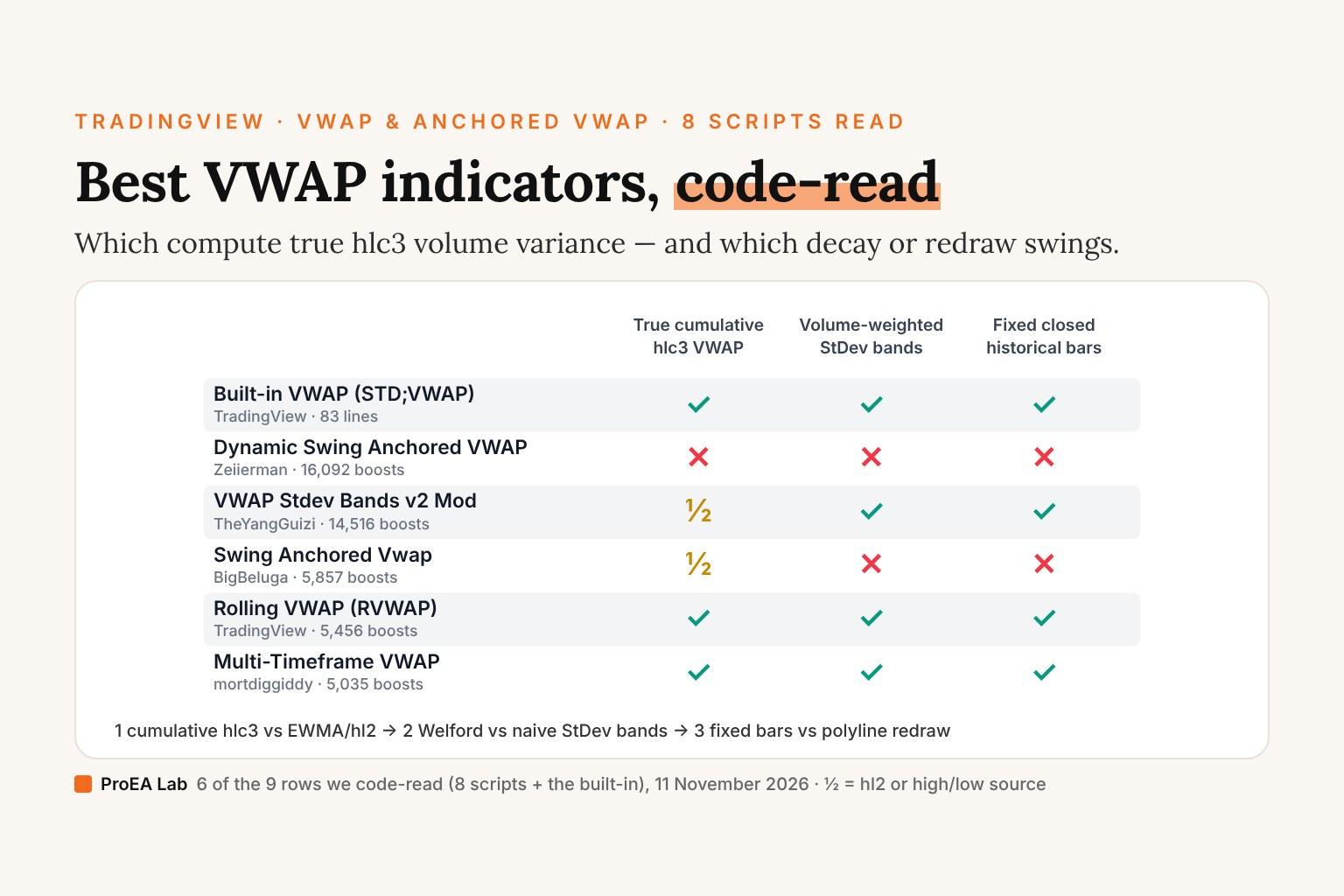
5,035 boosts) is the cleanest in our read—it plots Daily through Yearly hlc3 VWAP using numerically stable Welford variance with zero security() lookahead. For a single session, TradingView's built-in Volume-weighted average price (STD;VWAP) is clean Pine v6; for 24-hour markets without session jumps, TradingView's Rolling VWAP (5,456 boosts) wins. Meanwhile, the most-boosted script in our table (Dynamic Swing Anchored VWAP by Zeiierman, 16,092 boosts) isn't an equal-volume cumulative VWAP at all—it runs an EWMA half-life decay and redraws its polyline whenever a new 50-bar extreme prints.
Most roundups rank VWAP indicators by screenshot aesthetics.
We pulled their source files and read every line.
What we checked
On 11 November 2026 we searched TradingView's scripts for "vwap", "anchored vwap" and "vwap stdev", and read the Pine source of eight published open-source VWAP scripts and TradingView's built-in: the nine rows of the table below. (For a line-by-line interactive drill of TradingView's built-in STD;VWAP inputs, see our companion VWAP indicator settings code read.)
Three high-boost matches—RagingRocketBull's Volume Profile Free Ultra SLI (21,072 boosts) and Volume Profile Free Pro (7,460 boosts), and BigBeluga's VWAP Volume Profile (7,173 boosts)—are primarily horizontal TradingView Volume Profile histograms rather than session VWAP band tools, so they aren't in the table. Across the VWAP and Anchored VWAP scripts we read, we checked four code-level facts:
- True cumulative formula & price source: Does it compute equal-weighted
sum(price * volume) / sum(volume)onhlc3, or does it substitutehl2,close,high/low, or an exponential decay? - Anchor clock: When does the sum reset (
18:00 ETexchange"D",09:30 ETcash session, sliding window, 50-bar pivot, or visible chart edge)? - Standard deviation bands: Does it compute volume-weighted population variance, Welford incremental variance, or no bands at all?
- Historical stability & alerts: Once a candle closes, can scrolling, zooming, or future bars move past VWAP values—and do alerts wait for
barstate.isconfirmed?
The code-read table
TradingView's built-in and the eight published scripts we read; boosts as TradingView's search returned them on 11 November 2026:
| Script & author | Boosts | Formula & source | Anchor reset | StDev bands | Historical bars fixed? |
|---|---|---|---|---|---|
Built-in VWAP (STD;VWAP, TradingView) | Built-in | Cumulative ta.vwap, hlc3 | Session (timeframe.change("D")), W, M, 3M, 12M, corporate events | 1.0 on; 2.0, 3.0 off (or % mode) | Yes (zero alertcondition calls) |
Dynamic Swing Anchored VWAP (Zeiierman) | 16,092 | EWMA decay (baseAPT = 20), hlc3 | 50-bar ta.highest / ta.lowest pivot flip | None | No: vwap.poly.delete() redraws active swing on new highs/lows |
VWAP Stdev Bands v2 Mod (TheYangGuizi) | 14,516 | Cumulative sum, hl2 | security(tickerid, "D", time) (18:00 ET on Globex) | 1.28, 2.01, 2.51 on (3.09, 4.01 off) | Yes (legacy Pine v2; note fD2ppI7I UPDATE has a devDn4 typo on line 56) |
VWAP Periodic Close (LuxAlgo) | 6,800 | Prior period final ta.vwap, hlc3 | Carries forward closed D, W, M (Q, Y off) | None (horizontal close lines) | Yes (plots static prior-period close levels) |
Swing Anchored Vwap (BigBeluga) | 5,857 | Cumulative ta.vwap, high or low | high[1] == h[1] and high < h (1 bar after 50-bar pivot!) | None | No: poly.delete() redraws active polyline when trend updates |
Rolling VWAP (TradingView) | 5,456 | Sliding time-window sum, hlc3 | Never resets—auto-scales window (4H on 5m, 1D on 1H) | 3 StDev bands (0.0 off by default) | Yes (Pine v6; clean gap handling via minBarsInput = 10) |
Multi-Timeframe VWAP (mortdiggiddy) | 5,035 | Cumulative + Welford variance, hlc3 | Plots D, W, M, 3M, 12M together (ta.change(time(...))) | 1.0, 2.0, 3.0 on chosen TF + prior-close VWAP | Yes (Pine v5; numerically stable variance on line 58) |
Event Based VWAP Bands (LuxAlgo) | 4,783 | Cumulative sum, close default | Defaults to Periodic (t % 14 == 0, every 14 bars!) or interactive Start | ±2.0 StDev on | Yes once anchored, though default 14-bar reset surprises session traders |
Chart VWAP (TradingView) | 4,151 | Cumulative ta.vwap, hlc3 | time == chart.left_visible_bar_time (line 73) | 1 StDev pair (0.0 off by default) | Viewport-dependent: scrolling or zooming shifts the anchor bar and recalculates every point |
Seven protected scripts came up in the same search (Rolling Anchored Vwap Experimental by spacemanbtc, Anchored VWAP w/ Stdev and VWMA Cloud by DasanC, Pivot/TimeFrame Anchored VWAP - JD by Duyck, 1Q8urNcT, kFjrKxlk, fPoiakXI, and QeEjfZdY), and two invite-only ones (m7JiF0ZY, ZYfDqgDn); because their Pine code is hidden, we don't grade them.
Four surprises hidden inside the top scripts
1. Both top "Swing Anchored VWAP" scripts diverge from textbook AVWAP
Traders who add Zeiierman's Dynamic Swing Anchored VWAP (16,092 boosts) or BigBeluga's Swing Anchored Vwap (5,857 boosts) usually expect Brian Shannon's classic Anchored VWAP: equal cumulative (hlc3 * volume) / volume starting on the exact swing-high or swing-low candle. Reading both files shows something very different:
Zeiierman(SxgyrEde, lines 65–68 & 107–109): Instead of summing volume equally across the swing,alpha = 1.0 - math.exp(-math.log(2.0) / apt)applies an exponential half-life (apt = 20adjusted by ATR ratio) so older anchor volume decays away.BigBeluga(raqN2Ifz, lines 31–42): Callsh_vwap = ta.vwap(high, high[1] == h[1] and high < h). Because that reset boolean fires on the candle after the 50-bar high (high < h), the climax pivot bar's own volume—often the single heaviest volume bar of the entire turn—is excluded from the new VWAP sum! It also weightshigh(for resistance) andlow(for support) rather thanhlc3.- Both call
.delete()on their activepolylinewhenever price extends the 50-bar high or low (see our indicator repainting audit guide for why dynamic swing polylines look cleaner in hindsight than live).
2. Why mortdiggiddy's dQF211AS has the cleanest variance math in the list
Three legacy Pine v2/v3 scripts we read—TheYangGuizi's n1Ub6FXK (14,516 boosts), fD2ppI7I (6,867 boosts) and n2F64NVO (5,959 boosts)—compute variance via v2sum / volumesum - myvwap * myvwap. On long Yearly anchors or high-priced instruments like BTCUSDT (70,000+) and NQ1! (20,000+), subtracting two huge floating-point squares risks rounding drift. On lines 57–59 of dQF211AS, mortdiggiddy implements Tony Finch / Welford's incremental weighted variance:
Sn := newSession ? 0 : nz(Sn[1]) + volume * (hlc3 - nz(v[1])) * (hlc3 - v)
std = math.sqrt(Sn / vol)
That keeps Sn strictly non-negative across multi-month anchors without max(..., 0) clamping hacks, while plotting Daily, Weekly, Monthly, Quarterly, and Yearly VWAPs in a single overlay slot (handy if you want to save indicator slots without running our Pine Script indicator merger).
3. Check Event and Year inputs on community "Anchored VWAP" scripts
Two mid-table traps catch traders every week:
- LuxAlgo's
Event Based VWAP Bands(x20TQQYT,4,783boosts): Line 15 setsevent = input.string('Periodic', ...)and line 10 setslength = 14, so out of the boxt % 14 == 0resets VWAP every 14 candles usingclose(line 12) rather than anchoring to a session or swing! Switcheventto'Start'if you want interactive click-to-anchor behavior (input.time(0, confirm = true)on line 7). jamiespips'sAnchored VWAP(AqvAwrfM,4,493boosts): An 18-line Pine v2 script from October 2017 whose default timestamp is10 Oct 2017 12:00(lines 3–10) tested with exact equalitytimestamp(...) == time. On any modern chart where you forget to type an exact candle open timestamp,startSessionstays0forever and the line simply plots cumulativeohlc4VWAP from the first loaded bar on the chart.
4. None of the eight in the table anchors to the 09:30 ET futures cash open
On ES1!, NQ1!, MES1!, and MNQ1! charts set to Electronic (ETH) hours, timeframe.change("D") resets at 18:00 ET Globex, carrying 15.5 hours of Asia and London volume into the New York equity open (compare our Opening Range Breakout guide and Initial Balance vs Opening Range breakdown). A dedicated session-anchored script does exist (VWAP Market Session Anchored by DeltaSeek, zNkHo9a3), with 576 boosts on 11 November 2026.
Clean Pine Script v6: NY 09:30 ET Cash + Exchange Session + Weekly VWAP with Welford Bands
If you want one lightweight //@version=6 overlay that combines 09:30 ET New York Cash Open VWAP, Weekly VWAP, numerically stable Welford volume-weighted StDev bands (1.0 / 2.0 or 1.28 / 2.01), prior-session closing VWAP, and barstate.isconfirmed alerts—ready to pair with Squeeze Momentum compression or Lorentzian Classification—drop this directly into TradingView's Pine Editor:
//@version=6
indicator("ProEA RTH 09:30 + Weekly VWAP & Welford Bands (v6)", shorttitle = "VWAP RTH+W v6", overlay = true)

mode       = input.string("NY 09:30 Cash Open", "Primary Anchor", options = ["NY 09:30 Cash Open", "Exchange Day (D)"])
rthSession = input.session("0930-1600", "NY Cash Session")
rthTz      = input.string("America/New_York", "Session Timezone")
src        = input.source(hlc3, "Source")
mult1      = input.float(1.0, "Band #1 StDev (try 1.28)", minval = 0.1, step = 0.05)
mult2      = input.float(2.0, "Band #2 StDev (try 2.01)", minval = 0.1, step = 0.05)
showWeekly = input.bool(true, "Plot Weekly VWAP")
showPrior  = input.bool(true, "Plot Prior Session Closing VWAP")

bool inRth    = not na(time(timeframe.period, rthSession, rthTz))
bool rthStart = inRth and not inRth[1]
bool resetPri = mode == "NY 09:30 Cash Open" ? rthStart : timeframe.change("D")
bool resetWk  = timeframe.change("W")

// Numerically stable incremental Welford volume-weighted mean & variance
var float volSum  = 0.0
var float meanVal = na
var float m2Sum   = 0.0
var float prevCloseVwap = na

if resetPri and not na(meanVal[1])
    prevCloseVwap := meanVal[1]

if barstate.isfirst or resetPri
    volSum  := volume
    meanVal := src
    m2Sum   := 0.0
else if mode != "NY 09:30 Cash Open" or inRth
    float newVol = volSum + volume
    if newVol > 0.0
        float prevMean = nz(meanVal, src)
        float nextMean = prevMean + (volume / newVol) * (src - prevMean)
        m2Sum   += volume * (src - prevMean) * (src - nextMean)
        volSum  := newVol
        meanVal := nextMean

bool active   = (mode != "NY 09:30 Cash Open" or inRth) and volSum > 0.0
float vwapPri = active ? meanVal : na
float stdev   = active ? math.sqrt(math.max(0.0, m2Sum / volSum)) : na
[vwapWk, _, _] = ta.vwap(src, resetWk, 1.0)

plot(vwapPri, "Primary VWAP", color = #2563eb, linewidth = 2, style = plot.style_linebr)
pU1 = plot(active ? vwapPri + stdev * mult1 : na, "+Band 1", color = #16a34a, style = plot.style_linebr)
pL1 = plot(active ? vwapPri - stdev * mult1 : na, "-Band 1", color = #16a34a, style = plot.style_linebr)
fill(pU1, pL1, color = color.new(#16a34a, 93), title = "Band 1 Fill")
plot(active ? vwapPri + stdev * mult2 : na, "+Band 2", color = #ea580c, style = plot.style_linebr)
plot(active ? vwapPri - stdev * mult2 : na, "-Band 2", color = #ea580c, style = plot.style_linebr)
plot(showWeekly ? vwapWk : na, "Weekly VWAP", color = #7c3aed, linewidth = 2)
plot(showPrior ? prevCloseVwap : na, "Prior Session Close VWAP", color = #64748b, style = plot.style_circles)

bool reclaimUp = barstate.isconfirmed and ta.crossover(close, vwapPri)
bool rejectDn  = barstate.isconfirmed and ta.crossunder(close, vwapPri)
alertcondition(reclaimUp, "Confirmed Close Above RTH VWAP", "Confirmed close above RTH VWAP on {{ticker}} ({{interval}})")
alertcondition(rejectDn, "Confirmed Close Below RTH VWAP", "Confirmed close below RTH VWAP on {{ticker}} ({{interval}})")
Ours, and when to use Volume Profile alongside VWAP
VWAP tracks the single volume-weighted mean price of an anchor period; it cannot show you when an intraday auction splits into a double distribution with a low-volume air pocket right where the VWAP line sits. In Pine Pro Library ($49 once, full Pine Script v6 source), Volume Profile Lite maps the actual price histogram, Point of Control (POC), and Value Area alongside our empirical Volume Profile auction study, while Opening Range Desk handles the 09:30 ET New York cash-open range on closed candles.
If you are migrating custom VWAP or anchored-band code from cTrader C#, MetaTrader 5, MetaTrader 4, or NinjaTrader 8 onto TradingView—or upgrading older Pine v2/v4 VWAP scripts like n1Ub6FXK—run them through our free cTrader to Pine Script v6 converter, MQL5 to Pine Script v6 converter, NinjaScript to Pine Script v6 converter, or Pine v5 to v6 converter, and verify transaction costs in TradingView's tester first (backtesting guide).
Limits
Code read performed on 11 November 2026 against the exact Pine versions TradingView served that day. Authors can update scripts at any time, and boost totals measure community popularity rather than statistical edge. ProEA builds Pine Pro Library and has no affiliation with any TradingView author named above. Nothing here is financial advice.
Frequently asked questions
What is the best free VWAP indicator on TradingView?
Of the eight scripts and the built-in in our table: for Daily, Weekly, Monthly, Quarterly and Yearly cumulative VWAP on one chart, Multi-Timeframe VWAP by mortdiggiddy (5,035 boosts) is the cleanest—it weights hlc3, computes Welford incremental variance without security() lookahead, and optionally plots prior-period closing VWAP. For a single session with bands, TradingView's built-in Volume-weighted average price (STD;VWAP) is clean Pine v6; for 24-hour crypto or FX without session resets, TradingView's Rolling VWAP (5,456 boosts) slides a time window smoothly.
Which Anchored VWAP indicator on TradingView is best?
TradingView's built-in left-toolbar Anchored VWAP drawing tool is the most reliable manual click-to-anchor option because it pins directly to the bar timestamp you click without redrawing. Among script overlays, watch out for Dynamic Swing Anchored VWAP by Zeiierman (16,092 boosts) and Swing Anchored Vwap by BigBeluga (5,857 boosts): both delete and redraw their active polyline.new() whenever a new 50-bar high or low forms, and Zeiierman's weights volume with an exponential decay (baseAPT = 20) rather than equal cumulative volume.
What is the difference between VWAP Stdev Bands v2 Mod (TheYangGuizi) and TradingView's built-in VWAP?
TheYangGuizi's VWAP Stdev Bands v2 Mod (14,516 boosts) is a legacy Pine v2 script that weights hl2 instead of hlc3 and enables three bell-curve Z-score band pairs out of the box (1.28, 2.01, and 2.51, with 3.09 and 4.01 optional). TradingView's built-in STD;VWAP (83 lines, Pine v6) weights hlc3 and ships 1.0 enabled with 2.0 and 3.0 unchecked—you can type 1.28, 2.01 and 2.51 directly into the built-in's three multiplier fields.
Do any of the popular TradingView VWAP scripts anchor to the 09:30 AM New York cash open on futures?
None of the eight scripts in our table, and not the built-in, resets automatically at 09:30 ET when placed on a 24-hour Electronic Trading Hours (ETH) CME futures chart (ES, NQ, MES, MNQ). The period-based ones call timeframe.change('D') or change(time('D')), which fires at the 18:00 ET Globex open. To anchor at 09:30 ET without switching the whole chart to RTH, use an explicit 0930-1600 America/New_York session check like the Pine v6 script included below.
Do VWAP indicators on TradingView repaint?
Period-anchored cumulative scripts—STD;VWAP, mortdiggiddy's Multi-Timeframe VWAP, TheYangGuizi's VWAP Stdev Bands v2 Mod, and TradingView's Rolling VWAP—never alter closed historical candles. By contrast, swing-anchored scripts (Zeiierman's SxgyrEde and BigBeluga's raqN2Ifz) delete and redraw their active polyline when price sets a new 50-bar extreme, and TradingView's Chart VWAP (QE4dq4ZM) recalculates every bar whenever you scroll or zoom because it anchors to chart.left_visible_bar_time.
Why do Volume Profile indicators show up when searching VWAP on TradingView?
Two high-boost matches for 'vwap' in TradingView's script search on 11 November 2026—RagingRocketBull's Volume Profile Free Ultra SLI (21,072 boosts) and Volume Profile Free Pro (7,460 boosts)—are horizontal Volume Profile histograms that include VWAP in their titles and optional overlays rather than standalone session VWAP band indicators.