Download the XAUUSD trading journal as an Excel workbook (.xlsx), which you can import into Google Sheets, or a CSV with the values but no formulas. It is our free trading journal template made for gold: you type the prices, the lots, the commission and the swap, and Risk, Result, R and Win/Loss are formulas, worked out from one cell on the Settings sheet, the ounces per lot, 100 by default. No email, no account.
Three example gold trades come filled in: an overnight win that paid swap, a stop-out with slippage and an oversized trade. Delete them and log one row per closed gold trade.
Gold moves in dollars an ounce, and your account moves in dollars. The journal counts both, and never a pip.What's in the XAUUSD trading journal template?
The Trades sheet keeps the free template's eighteen columns, A to R, in the same places, with the size column named Lots. Risk and Result become formulas, and two columns follow from S:
| Column | Typed or formula | What it holds |
|---|---|---|
Risk (account currency) | Formula | |Entry − Stop| × ounces per lot × Lots |
Result (account currency) | Formula | (Exit − Entry) × ounces per lot × Lots, sign flipped for a short, minus Fees, plus Swap |
R multiple, Win/Loss | Formula | Result ÷ Risk, and its sign, as in the free template |
Fees | Typed | The commission, as a positive number |
Swap | Typed | The swap on the trade, negative when you paid it |
Price move at risk ($ an ounce) | Formula | |Entry − Stop|: the stop's distance in dollars an ounce |
The Settings sheet holds one cell, Ounces per lot, set to 100, with the note "Most brokers' XAUUSD contract: 1 lot = 100 troy ounces. Check yours in the symbol's specification." The Summary is the template's own (win rate, expectancy, profit factor, the plan-followed split) plus one line, Total swap. Risk and Result on row 2:
=IF(OR(E2="",F2="",I2=""),"",ABS(E2-F2)*Settings!$B$2*I2)
=IF(OR(E2="",H2="",I2=""),"",(H2-E2)*IF($C2="Short",-1,1)*Settings!$B$2*I2-N2+S2)
One difference from the free template: there, Fees holds commission and swap together. Here swap has its own column, because on gold it is the price of holding overnight, and the weekly review should see it apart.
Why does a gold trading journal count dollars, not pips?
Because a gold "pip" isn't one thing. The workbook's Read me puts it in one line: "Brokers disagree on what a gold 'pip' is (0.01 or 0.10), so this sheet counts dollars, not pips." The example's second trade has its stop $2.50 above the entry: that is 25 pips if a pip is 0.10 and 250 pips if it is 0.01. Same trade, same $50 at risk. Our pip value calculator's XAUUSD preset calls $0.10 a pip, but your broker may not, so the journal keeps the stop as Price move at risk ($ an ounce) and never asks for pips.
The dollars come from the ounces per lot. The Read me again: "A $1 move in gold is $100 a lot at 100 ounces, $10 on 0.10 lots." So a $5 stop on 0.10 lots is $50 of risk. Some brokers use another contract size: in MT5, open Market Watch, right-click the gold symbol and choose Specification, then copy the contract size into the Settings cell. Every Risk and Result follows that one cell. Is 1 lot 100 oz at your broker? covers the contract in full, and the XAUUSD lot size calculator turns a risk budget and a stop in dollars into lots.
Three gold trades, worked
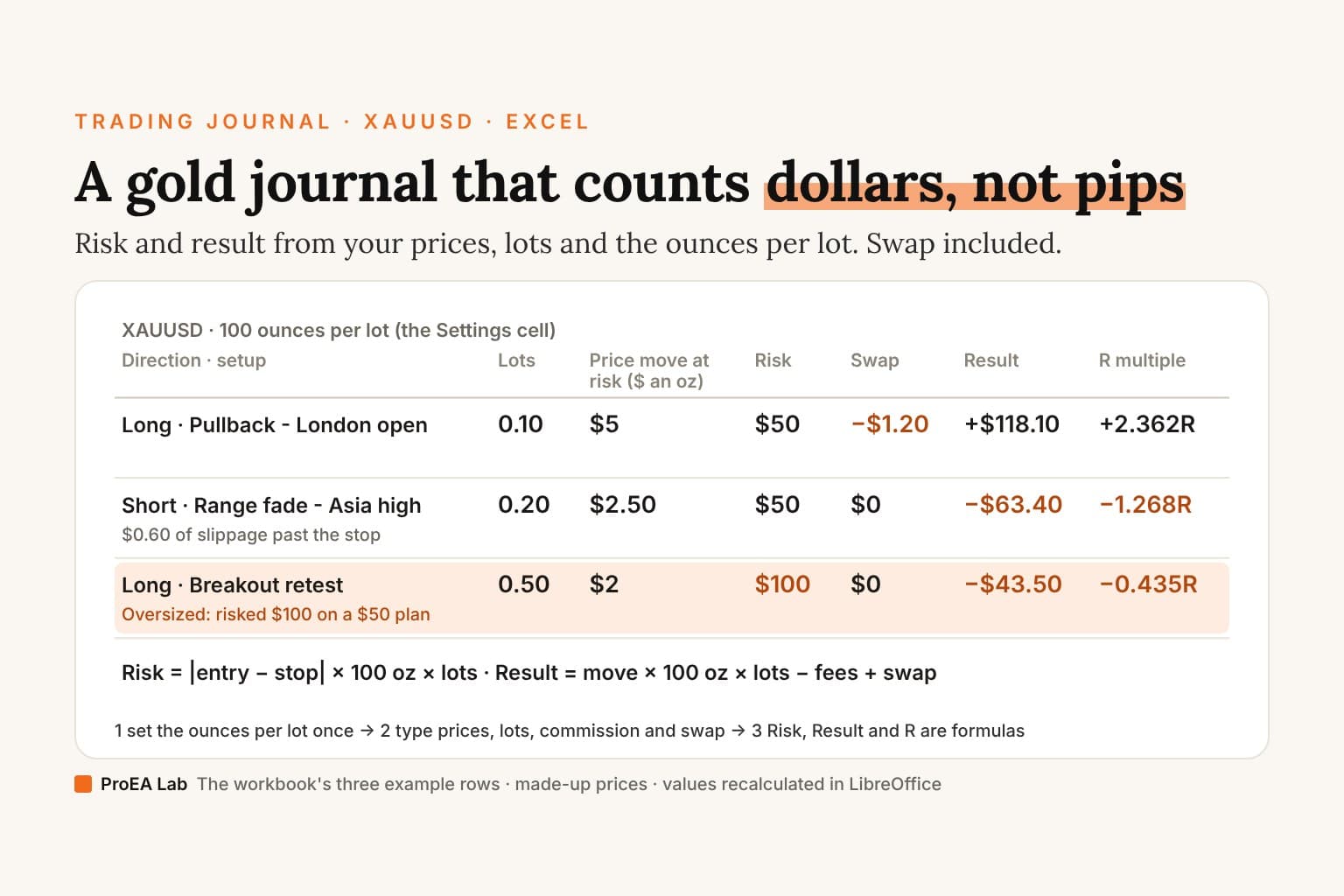
The workbook's three example rows, at 100 ounces per lot. They are made up, with prices that are not quotes:
| Date | Trade | Entry, stop, exit | Lots | Price move at risk | Risk | Fees | Swap | Result | R |
|---|---|---|---|---|---|---|---|---|---|
| 2026-10-05 | Long, Pullback - London open | 3350.00, 3345.00, 3362.00 | 0.10 | $5 | $50 | $0.70 | −$1.20 | +$118.10 | +2.362R |
| 2026-10-06 | Short, Range fade - Asia high | 3360.50, 3363.00, 3363.60 | 0.20 | $2.50 | $50 | $1.40 | $0 | −$63.40 | −1.268R |
| 2026-10-07 | Long, Breakout retest | 3340.00, 3338.00, 3339.20 | 0.50 | $2 | $100 | $3.50 | $0 | −$43.50 | −0.435R |
The overnight win. A long at 3350.00 with the stop $5 below: $5 × 100 × 0.10 = $50 at risk. It was held overnight and hit the 3362.00 target the next morning. The $12 move is worth $120 on 0.10 lots; take off $0.70 of commission and $1.20 of swap, and the result is +$118.10: +2.362R. The swap cost 0.024R, small on one night, and the Summary's Total swap keeps the running count.
The stop-out with slippage. A short at 3360.50 with the stop at 3363.00: $2.50 × 100 × 0.20 = $50 at risk. It filled at 3363.60, $0.60 past the stop. The $3.10 move against it is $62 on 0.20 lots, plus $1.40 of commission: −$63.40, −1.268R. The slippage cost $12 (0.24R) and the commission 0.028R. Followed plan? is Y: a fill past the stop is a cost of trading gold, and the review counts it as a cost, not a mistake.
The oversized trade. A long at 3340.00 with a $2 stop, on 0.50 lots: Risk $100. The row's note says it: "Risked $100 on a $50 plan: 0.50 lots on a $2 stop, twice the 0.25 lots the plan allowed." They are also five times the 0.10 lots of the first trade. It closed at 3339.20 for −$43.50 after $3.50 of commission: −0.435R, with Followed plan? N and the mistake tag Oversized.
That −0.435R looks mild, and it is the reason to read the Risk column. R divides by the $100 the trade actually risked. Against the $50 plan, the same −$43.50 is −0.87R, and a full stop-out would have cost $103.50, more than twice the plan. R measures a trade against its own risk, so an oversized trade hides in R; a $100 in a column of $50s doesn't.
The Summary on the three rows: 3 trades, 1 win, +$11.20 in total after $5.60 of commission and −$1.20 of swap, +0.22R expectancy, a profit factor of 1.10 and a largest loss of −1.268R. The two trades marked Y average +0.55R; the one marked N, −0.435R. Three made-up rows are a worked example, not evidence of anything.
How do I fill the gold trading journal from MT5?
Export your history from Toolbox → History, right-click the list, choose the period, then Report. Then copy each closed gold position from the report's Positions table, as the free template's MT5 guide does, with the changes this edition needs:
| Journal column | From the MT5 report |
|---|---|
| Date | Close time |
| Symbol, Direction (Long/Short) | Symbol; Type: buy is Long, sell is Short |
| Entry, Target, Exit | Opening price, T / P, Closing price |
| Stop | Your initial stop. The report's S / L column may show the stop as it was last set |
| Lots | Volume |
| Fees | Commission, as a positive number |
| Swap | Swap, as the report signs it: a charge is negative |
| Risk, Result | Don't type them: they are formulas |
Then check one row: the journal's Result should equal the report's Profit + Commission + Swap. If it doesn't, the ounces per lot or a price is wrong. The formulas count in US dollars, the currency gold is priced in; on an account in another currency, type Risk and Result from your statement over the formulas. The free MT5 report analyzer reads the report in your browser first, if you want the totals before you copy.
What should a gold trader review each week?
The free template's five numbers still lead: total trades, expectancy in R, plan Y against plan N, the largest loss in R and the profit factor. Gold adds three checks:
- Session. This edition has no Session column, so name the session in the setup, as the examples do ("Pullback - London open", "Range fade - Asia high"), and filter or pivot the Setup column for each session's average R. Gold's typical swing differs by session; the XAUUSD ADR stop-loss calculator turns your 14-day average daily range into a typical swing and a stop for the Asian, London and New York sessions. If your setups trade the session sweeps, a gold liquidity sweep strategy names the pools on the New York clock, and our two pre-registered gold sweep studies show why no setting we tested passed.
- Size discipline. Every Risk should be your planned amount. Sort the Risk column: a $100 among $50s is an oversized trade, whatever its R. Then compare Lots with Price move at risk: a $2 stop on 0.50 lots risks the same $100 as a $5 stop on 0.20 lots, and a tight stop is where a big size creeps in. Count the Oversized tags.
- Swap. The Summary's Total swap is what holding overnight cost, −$1.20 on the example. Check which night your broker charges three times: the swap calculator notes that many brokers charge or credit three nights on Wednesday for currency pairs, and some CFDs on indices or commodities on Friday, and it turns your broker's swap points into money before you hold.
On the example the five numbers read 3 trades, +0.22R, Y +0.55R against N −0.435R, a largest loss of −1.268R and a profit factor of 1.10. Write down the one leak that cost the most R this week and the one rule it becomes.
The deep version, as a PDF
The Trading Journal Playbook
What to write on every trade and why, filled-in entries across markets, the pre-trade checklist, the weekly and monthly review with the arithmetic shown, and the same columns on paper, in a spreadsheet or an app.
- What to write on every trade, and why each of the template's eighteen columns exists, in the order you fill them
- 13 filled-in entries across forex, gold, an index CFD, a partial close, a prop-firm evaluation day, a skipped trade and a backtest, every Risk, Result and R worked from the prices
- The pre-trade checklist, and how a month of mistake tags turns into checks of your own
Opens soon · USD 19, one payment. See what's inside →
Gold trading journal in Excel, PDF or an app?
Start with the one you will keep filling. The columns matter more than the medium.
- This Excel workbook does the gold arithmetic for you: risk from the stop, ounces and lots, result with swap, R and the weekly numbers. Typing each trade is the cost.
- The printable trading journal is a six-page PDF with the same core columns, counted in R. It has no ounces-per-lot or swap column: work out risk as stop × ounces × lots by hand, and write the result net of swap.
- A journal app imports the trades, so no day goes missing. Ours, TradeLens, imports MT4 statements and MT5 history, and takes broker CSVs through a column-mapping wizard, and reviews what pays and what leaks by symbol and session on your own computer; its AI coach answers with figures computed in code. It's $47 at launch ($79 regular), one payment.
If you trade gold with an EA, Everyone was a gold genius shows how a rising gold price can flatter a long-biased backtest. For gold indicators, see the best gold indicators on TradingView, code-read.
Frequently asked questions
Is there a free XAUUSD trading journal template?
Yes. Download it as an Excel workbook (.xlsx) or a CSV for Google Sheets: no email, no account. Upload the .xlsx to Google Sheets to keep its formulas; the CSV carries the three example rows with their worked-out values but no formulas, so rows you add to it won't calculate.
How do you calculate risk on a gold trade?
Multiply the stop's distance in dollars an ounce by the ounces per lot and by your lots. With 100 ounces per lot, a $5 stop on 0.10 lots risks $50, and so does a $2.50 stop on 0.20 lots. The journal's Risk column is that formula.
Why does the journal count dollars instead of pips?
Because brokers disagree on what a gold pip is: 0.01 or 0.10 of the price. The example's $2.50 stop is 250 pips at 0.01 and 25 pips at 0.10. A distance in dollars an ounce means the same at every broker.
How many ounces are in a lot of gold?
On most brokers' XAUUSD contract, 100 troy ounces, which is the Settings sheet's default. Some brokers and account types use another size: check the symbol's Specification in MT5 and change the one cell if yours differs. Every Risk and Result follows it.
How do I record swap in a gold trading journal?
Type the swap on the trade in the Swap column, negative when you paid it. Result adds it, so the example's overnight win of $118.10 is net of $1.20 of swap and $0.70 of commission, and the Summary totals the swap.
What should a gold trader review each week?
Average R by session, size discipline and swap. Name the session in the setup so the sessions can be compared. Read the Risk column for any amount above your plan, because R hides an oversized trade: the example's 0.50-lot trade shows −0.435R against the $100 it risked, but −0.87R against its $50 plan.
Is there a gold trading journal PDF?
Our printable trading journal is a six-page PDF with the same core columns, counted in R. It has no ounces-per-lot or swap column: on paper, work out the risk as the stop in dollars times ounces times lots, and write the result net of swap.