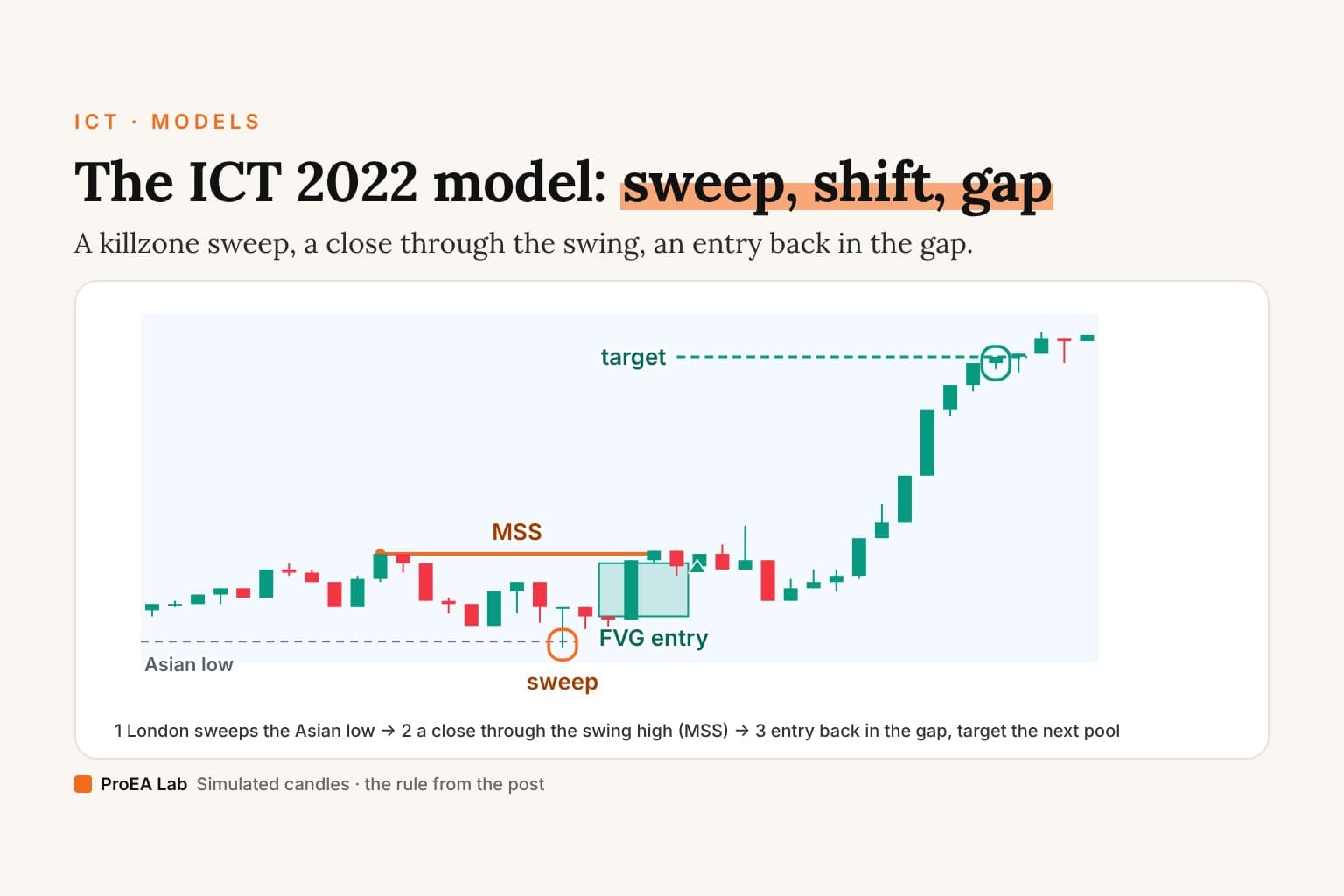
The ICT 2022 model is a five-step sequence: price sweeps a high or low marked in advance inside a killzone, displaces back through the last opposing swing (a market structure shift), leaves a fair value gap in that leg, and is entered when it trades back into the gap, with the stop beyond the swept extreme and the target at the liquidity on the other side. Our Sweep Desk runs that whole sequence on closed candles once four settings are changed. We haven't measured it that way.
Every replay below is simulated 5-minute candles on the New York clock, read by the rule at the bottom of this page, with Sweep Desk 2.0.0's numbers.
A sweep, a shift, a gap, a return. Miss one and it isn't the model.What is the ICT 2022 model?
An intraday entry model from the free mentorship that ICT, the Inner Circle Trader (Michael J. Huddleston), posted on YouTube in 2022. Viewers named it after the year. LuxAlgo's library entry (no date shown, checked 2026-10-08) calls it "a fixed three-beat sequence: raid, shift, entry", and is plain about the name: "'Model 2022' is community shorthand rather than a formal spec".
Simulated 5-minute candles, not market data. Times are New York. The rule uses Sweep Desk's numbers; its pools here are 5-a-side swings and the killzones' highs and lows (the rule's other pools aren't simulated).
Read as text
- Simulated 5-minute candles, 01:15 to 05:10 New York time. The pool: the Asian low, 74.80, printed at 23:40 the evening before.
- 03:15, inside London (02:00–05:00): a candle trades to 74.78, 0.28 ATR below the Asian low, and closes back above it at 74.91. That's the sweep: a long idea.
- The swing the shift has to break is the last swing high confirmed when the sweep closed (3 candles on each side): 75.08, at 02:35.
- 03:35: a candle closes at 75.09, above 75.08 and 0.31 from the low of 74.78 (1 ATR is about 0.07): the market structure shift, 4 candles after the sweep.
- The leg from the sweep left a bullish fair value gap, 74.88 to 75.05 (the candles 03:25 to 03:35). Its near edge, 75.05, is the limit. Stop: 74.77, 0.10 ATR below the low. Target: the nearest resting pool at least 2R away, the swing high at 75.71 (printed at 12:40 the day before).
- 03:40: price trades back into the gap and the limit fills at 75.05.
- 04:30: price reaches 1R and the stop moves to the entry, 75.05; 04:40: price reaches 2R and the stop moves to 1R, 75.33. Neither takes profit.
- 04:50: price reaches the target, 75.71: +2.4R, 19 candles after the sweep.
- One setup from start to finish, on simulated candles. It shows the sequence, not how often it pays.
How this window was chosen: The first long setup in the simulated year that starts with a sweep of a killzone's low (not a plain swing low) and runs the whole rule to its target within 3 hours of the sweep, where the swing the shift has to break is also the highest price between that swing and the sweep (so the line the rule uses is the one the eye picks). The film runs from 2 hours before the sweep to 4 candles after the target. No two films share a candle.
Use itMark the pools before the session, then read the five steps in order on closed candles: sweep, shift, gap, return, exit.
Watch outA finished chart always shows a sweep somewhere. A pool named after the move fits any wick.
What are the ICT 2022 model steps, in order?
Five, and the order is part of the rule. ATR is ATR(14); a swept low starts a long idea, a swept high a short one.
| Step | What has to happen | Written down in |
|---|---|---|
| 1. Draw on liquidity | Pools named before price gets there: confirmed swing highs and lows (5 candles a side), 60-minute swings, equal highs or lows, the previous day's and week's high and low, each killzone's high and low once it ends | liquidity sweep |
| 2. Sweep, in a killzone | A candle that opens inside London (02:00–05:00), New York AM (08:30–11:00) or New York PM (13:30–16:00) wicks at least 0.05 ATR beyond a pool and closes back inside | ICT killzones |
| 3. Displacement and MSS | Within 12 candles, a close beyond the last opposing swing (3 candles a side), at least 1 ATR from the sweep's extreme | BOS vs CHoCH |
| 4. The gap | The nearest fair value gap at least 0.10 ATR wide in the leg from the sweep, found within 8 candles of the shift | fair value gap |
| 5. Entry, stop, target | A limit in the gap, a stop past the swept extreme, a target at the nearest opposing pool at least 2R away | below |
Step 3 separates the model from a plain sweep trade. Two details decide it on a real chart:
- Which swing. Sweep Desk fixes it when the sweep candle closes: the last swing confirmed by then. A swing that forms after the sweep doesn't count, even if price closes through it first.
- How much force. Sweep Desk's is distance, the close at least 1 ATR from the extreme: "a real push, not a drift". tradeforopp's ICT 2022 Mentorship Model script on TradingView (published 4 Dec 2022, checked 2026-10-08, closed source) counts a bar's range against "the standard deviation of recent price history", times a strength its author prefers at 3 or more. Same word, two filters.
Simulated 5-minute candles, not market data. Times are New York. The rule uses Sweep Desk's numbers; its pools here are 5-a-side swings and the killzones' highs and lows (the rule's other pools aren't simulated).
Read as text
- Simulated 5-minute candles, 02:35 to 06:05 New York time. The pool: the Asian high, 91.79, printed at 20:00 the evening before.
- 04:35, inside London: a candle trades to 91.87, 0.68 ATR above the Asian high, and closes back below it at 91.70. A sweep, inside the killzone: a short idea.
- The swing the shift has to break: the swing low at 91.38 (04:00). The rule gives it 12 candles, to 05:35.
- The nearest close comes at 04:45: 91.54, still above 91.38. No close in the 12 candles gets below it, and none gets below any later swing low either.
- No shift, so no gap is looked for and no order goes in. At 06:00 price trades above the sweep's high again.
How this window was chosen: The first sweep of a killzone's high or low in the simulated year with no shift in the 12 candles after it, where none of those candles closes beyond any later swing on that side either (no reading of the chart finds a shift). The film runs from 2 hours before the sweep to 6 candles after the 12th. No two films share a candle.
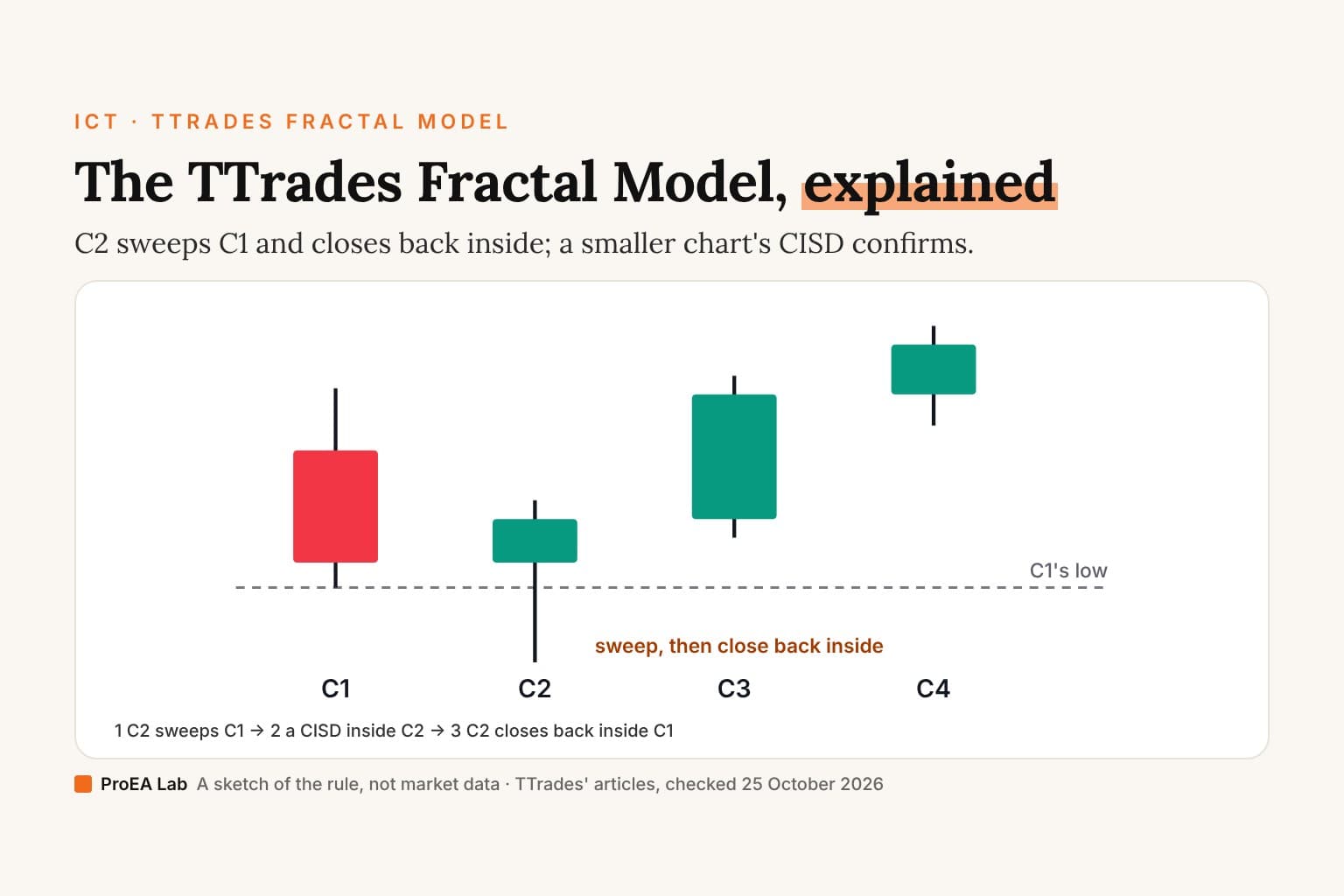
Each common swap-in makes a different model: a change in state of delivery (CISD) for an earlier shift (the Fractal Model built on it found no validated edge in our test of 108 versions on seven markets), the optimal trade entry (OTE), 62% to 79% back into the leg, for a deeper entry, or an inverse fair value gap. Pick before you look.
Which killzone, and which candle has to be inside it?
The model has no clock of its own. LuxAlgo: "Model 2022 is event-sequenced and can technically form at any hour". So the clock is a rule you add, in three decisions:
- Which windows. The set ICT Levels Desk and Sweep Desk ship: London 02:00–05:00, New York AM 08:30–11:00, New York PM 13:30–16:00. Asia's high and low are pools, not a sweep window.
- Which candle must be inside. Sweep Desk checks the sweep candle; the fill can come up to 30 candles after the gap arms, outside the window. Requiring the entry inside too is a stricter rule.
- Which clock. America/New_York, daylight saving time included. A window typed in UTC is an hour off for part of the year.
Simulated 5-minute candles, not market data. Times are New York. The rule uses Sweep Desk's numbers; its pools here are 5-a-side swings and the killzones' highs and lows (the rule's other pools aren't simulated).
Read as text
- Simulated 5-minute candles, 02:35 to 05:50 New York time. The pool: the swing high, 79.43, printed at 03:45.
- 04:35, inside London (02:00–05:00): a candle trades to 79.44, 0.13 ATR above the swing high, and closes back below it at 79.36. That's the sweep: a short idea.
- 05:00: the London killzone closes.
- The swing the shift has to break is the last swing low confirmed when the sweep closed (3 candles on each side): 79.17, at 04:10.
- 05:00: a candle closes at 79.16, below 79.17 and 0.28 from the high of 79.44 (1 ATR is about 0.08): the market structure shift, 5 candles after the sweep.
- The leg from the sweep left a bearish fair value gap, 79.20 to 79.27 (the candles 04:50 to 05:00). Its near edge, 79.20, is the limit. Stop: 79.45, 0.10 ATR above the high. Target: no resting pool at least 2R away, so 3R, 78.46.
- 05:10: price trades back into the gap and the limit fills at 79.20, 10 minutes after London closed.
- This page's rule (Sweep Desk's "Only sweeps inside a killzone") checks the sweep candle: it opened at 04:35, inside London, so the setup stands and the fill is a trade.
- The film ends 8 candles after the fill, wherever price is: what came next is not the point.
How this window was chosen: The first setup in the simulated year whose sweep candle opens inside a killzone and whose fill comes after that killzone has closed, within the hour after. The film runs from 2 hours before the sweep to 8 candles after the fill, whatever they do. No two films share a candle.
Use itDecide which candle has to sit inside the killzone, the sweep or the entry, before the window opens.
Watch outA sweep at 10:55 that fills at 11:40 is inside the window by one rule and outside it by the other. Two rules, two trade lists.
We haven't compared windows or timeframes for this model, so we don't rank them.
What are the entry, stop and target rules?
Entry. A limit at the gap's near edge ("FVG edge") or its midpoint ("CE (50%)"). Sweep Desk's default, "Confirmation close", enters on the shift, not the return into the gap, so change it.
Stop. The sweep's extreme plus 0.10 ATR. If price trades back beyond it, the sweep wasn't the turn.
Target. The liquidity on the other side: Sweep Desk's "Liquidity" target, the nearest untouched opposing pool at least 2R away, or 3R when none qualifies, frozen once the zone arms. Reaching 1R moves the stop to entry, 2R moves it to 1R; neither takes profit.
In a trade, a candle touching both stop and target counts as the stop, and 200 candles end it.
ICT 2022 model vs Silver Bullet vs Judas swing: what's the difference?
All three run liquidity, then trade the move back. Each column is the rule from its own page, New York time.
| ICT 2022 model | ICT Silver Bullet | Judas swing | |
|---|---|---|---|
| Clock | a killzone | one hour: 03:00, 10:00 or 14:00 | 00:00 to 05:00 |
| The level run | any pool named in advance | the nearest 15-minute swing high or low | the Asian range, 20:00 to 00:00 |
| What turns it | a close through the last opposing swing, 1 ATR from the extreme | nothing beyond the run | a close through the 00:00 open |
| The entry | a return into the gap the shift left | the first gap toward the draw | not fixed |
The ICT Silver Bullet is a clock first and a setup second; the 2022 model is a sequence first, with a clock added. The Judas swing names a direction, not an entry. One London morning can qualify for all three: a 03:00 run of the Asian low that closes back inside, then a close through the midnight open and the last swing high, and a gap before 04:00. Count it once.
Does the ICT 2022 model work?
A setup that meets every step can still lose. The replay below is the same rule on another simulated morning.
Simulated 5-minute candles, not market data. Times are New York. The rule uses Sweep Desk's numbers; its pools here are 5-a-side swings and the killzones' highs and lows (the rule's other pools aren't simulated).
Read as text
- Simulated 5-minute candles, 01:25 to 04:55 New York time. The pool: the swing high, 93.30, printed at 22:40 the evening before.
- 03:25, inside London (02:00–05:00): a candle trades to 93.32, 0.22 ATR above the swing high, and closes back below it at 93.20. That's the sweep: a short idea.
- The swing the shift has to break is the last swing low confirmed when the sweep closed (3 candles on each side): 92.97, at 03:10.
- 04:00: a candle closes at 92.95, below 92.97 and 0.42 from the high of 93.37 (a new high at 03:40) (1 ATR is about 0.10): the market structure shift, 7 candles after the sweep.
- The leg from the sweep left a bearish fair value gap, 93.11 to 93.18 (the candles 03:50 to 04:00). Its near edge, 93.11, is the limit. Stop: 93.38, 0.10 ATR above the high. Target: the nearest resting pool at least 2R away, the swing low at 92.31 (printed at 20:30 the evening before).
- 04:15: price trades back into the gap and the limit fills at 93.11.
- 04:20: a candle closes at 93.30, above the gap's far edge. Price went straight through it.
- 04:35: price reaches the stop at 93.38, 4 candles after the fill, before 1R: a loss of the planned risk.
- Every step of the rule was met. The sequence was right; the trade still lost.
How this window was chosen: The first setup in the simulated year that fills and then, on a later candle, hits its first stop (before 1R, before the target). The film runs from 2 hours before the sweep to 4 candles after the stop. No two films share a candle.
Random candles print the whole model too. In one simulated year of the killzones page's market, where nobody trades, the rule found 407 sweeps inside a killzone: 30 filled and 9 reached the target. Most never got that far: 248 closed 1 ATR back through the pool first. Seeing the sequence on a chart proves nothing by itself.
- Sweeps of a pool, inside a killzone407
- Shift within 12 candles79
248 closed 1 ATR back through the pool first · 80 got no shift
- A gap of 0.10 ATR or more in the leg (the plan is set)77
2 closed back beyond the extreme first
- Price came back and filled the limit30
46 ran to 1R without coming back · 1 not filled in 30 candles
- Reached the target9
of the 30 fills: 13 first stop · 6 stopped at the entry · 2 stopped at 1R
Simulated candles, not market data: nobody trades in this market, so every setup here is chance. The counts show how the rule filters, not what it earns.
LuxAlgo lands in the same place: "no published, independently verified track record establishes its edge."
A real test needs hundreds of trades on more than one market (our counts above run from 7 to 40), a period the rule never saw, as in a walk-forward test, and the same stop, target and clock without the sweep or the shift to beat. If removing a step changes nothing, it isn't doing the work. Until then, the 2022 model is a precise checklist, not a demonstrated edge.
What should you check before an ICT 2022 model trade?
What's the exact ICT 2022 model rule?
ICT 2022 model rule (our assembly, Sweep Desk 2.0.0 numbers)
Closed candles only. New York time. ATR = ATR(14).
1. Pools, named before price gets there: swing highs and
   lows (5 candles a side), 60-minute swings, equal highs
   or lows, the previous day's and week's high and low,
   each killzone's high and low once it ends.
2. Clock: the sweep candle opens inside London 02:00-05:00,
   New York AM 08:30-11:00 or New York PM 13:30-16:00.
3. Sweep: a wick at least 0.05 ATR beyond a pool, and the
   same candle closes back on the pool's side. Swept low =
   long idea; swept high = short idea.
4. Shift: within 12 candles, a close beyond the last
   opposing swing (3 candles a side; the last one confirmed
   when the sweep closes), at least 1 ATR from the sweep's
   extreme (a new extreme moves it). A close more than
   1 ATR back through the pool first = no trade.
5. Gap: the nearest fair value gap at least 0.10 ATR wide
   in the leg from the sweep, within 8 candles of the
   shift. A close back beyond the extreme first = no trade.
6. Entry: a limit at the gap's near edge, filled within
   30 candles. A close beyond the stop, or price reaching
   1R first = no trade.
7. Stop: the extreme plus 0.10 ATR. Target: the nearest
   untouched opposing pool at least 2R away, else 3R.
The sequence is ICT's; the numbers are Sweep Desk's defaults. Sweep Desk also requires, by default, a first touch of a completed 60-minute gap in the last 6 bars, which the 2022 model doesn't name: switch "Require first-touch HTF FVG delivery" off to run this rule. The replays use two kinds of pool, 5-a-side swings and the killzones' highs and lows; the others aren't simulated.
Which tools draw the ICT 2022 model?
The whole sequence on your own chart. Sweep Desk 2.0.0 marks the pools, the sweep, the MSS line and the gap in the shift leg, and plans the stop and targets on closed candles. For this page's rule, change four settings: Confirmation to "Structure shift (MSS)", Entry to "FVG edge" (or "CE (50%)"), "Only sweeps inside a killzone" on, Final target to "Liquidity", then decide on the 60-minute gate. Pine v6, full source in Pine Pro Library. New to Pine? Here's how to add a script to TradingView.
The pieces on their own, all in the same library: ICT Levels Desk boxes the killzones on the New York clock, Signal Desk labels BOS and CHoCH (5-candle swings; Sweep Desk's shift uses 3), SMC Basics draws gaps of at least 0.3 × ATR(14), so it can skip a narrow gap Sweep Desk keeps, IFVG Desk runs the inverted-gap variant and Fractal Model Desk the CISD one. None of ours draws OTE. Using a third-party SMC script for the pieces instead? We read the most-boosted SMC indicators on TradingView for live-bar signals and deleted zones.
Sweep Desk and IFVG Desk can also require an SMT divergence against a second market, off by default.
Every ICT model on one page, in learning order: ICT concepts. The structure and liquidity vocabulary underneath: smart money concepts.
The deep version, as a PDF
The Smart Money Concepts Rule Book
ICT and SMC as exact rules on closed candles, every concept set against the ones it's confused with, and what our data says about each.
- 26 SMC and ICT terms, each one closed-candle rule: BOS, CHoCH, MSS, order blocks, breakers, fair value gaps, sweeps, OTE, killzones, SMT and more
- The comparisons traders search for, side by side: BOS vs CHoCH vs MSS, breaker vs mitigation vs order block, sweep vs grab vs breakout, FVG vs imbalance vs IFVG
- Every measurement we've published on these concepts, with its sample, period and costs, and why the book prints no win rate
One payment, instant download. Refund within 7 days if you haven't downloaded it.
Disclosure
We build Sweep Desk, IFVG Desk, ICT Levels Desk, Signal Desk, SMC Basics, Gold Sweep Desk and Fractal Model Desk and sell them in Pine Pro Library, alongside our other indicators. We have no relationship with ICT, LuxAlgo, tradeforopp or TradingView. Nothing here is financial advice, and no 2022 model rule on this page, ours included, has a validated edge.
Use these animations on your site.
Frequently asked questions
What is the ICT 2022 model?
An intraday entry model from the free mentorship ICT posted on YouTube in 2022: price sweeps a high or low marked in advance inside a killzone, displaces back through the last opposing swing (a market structure shift), leaves a fair value gap in that leg, and is entered when it trades back into the gap. The stop goes beyond the swept extreme and the target at the liquidity on the other side.
What are the ICT 2022 model steps, in order?
Five, and the order is part of the rule: liquidity pools named before price gets there, a sweep inside a killzone, displacement and a market structure shift, a fair value gap in that leg, then the entry, stop and target.
What time is the ICT 2022 model traded?
The model has no clock of its own, so the killzone is a rule you add. This page uses the windows ICT Levels Desk and Sweep Desk ship, New York time: London 02:00–05:00, New York AM 08:30–11:00 and New York PM 13:30–16:00.
What are the entry, stop and target in the ICT 2022 model?
In this page's rule: a limit at the gap's near edge (or its midpoint), a stop at the swept extreme plus 0.10 ATR, and a target at the nearest untouched opposing pool at least 2R away, or 3R when none qualifies.
Is there an ICT 2022 model PDF?
Not a formal one. With no formal spec, any PDF is someone's notes on the videos; LuxAlgo calls 'Model 2022' community shorthand rather than a formal spec.
How is the ICT 2022 model different from the Silver Bullet?
The Silver Bullet is a clock first and a setup second: one hour (03:00, 10:00 or 14:00 New York) and the nearest 15-minute swing high or low. The 2022 model is a sequence first, with a clock added, and needs a close back inside on the sweep candle and a close through the last opposing swing.
Is there an indicator for the ICT 2022 model?
Our Sweep Desk runs the whole sequence on closed candles once four settings are changed: Confirmation to Structure shift (MSS), Entry to FVG edge or CE (50%), Only sweeps inside a killzone on, and Final target to Liquidity. We haven't measured it that way.
Does the ICT 2022 model work?
We haven't tested it as a whole: no ProEA study has run this rule as one setup. Its two closest measured pieces each changed sign from one chart to the other; Sweep Desk's v1 sweep-then-shift test on 15-minute candles, 1 June to 3 September 2026, made a profit factor of 2.908 on 14 gold trades and 0.86 on 16 bitcoin trades.